Thinking back to when it all started
wearing a tie and awful shoes
you said "I am yours", I answered "Don't bother"
but then I was caught even though I knew
Asking myself to think a bit harder
whatever you said made me see
that we would end up beating each other
and things that I want are in my dreams
You say how endlessly and helplessly
love me endlessly and hopelessly
I am alone and you look smarter
driving around in your fancy car
haven't been sad since we parted
'cause now I can do all I want to do
You say how endlessly and helplessly
love me endlessly and hopelessly
[from the lyrics of "Hopeless Case" by Cinnamon]
"Hopeless Case EP", Japanese Edition CD single, Booklet front and rear
Guitarist Jiri Adamik-Novak (...now a successful designer...) was born and raised in Prague and lived in Sierra Leone for a while. He and Frida met for the first time in 1992 when she joined Jiri's band of that time (Love on Ice, named after a song by Momus).
In 1993, after having dissolved the band, they started co-writing and recording songs that eventually found their way to Lars Tengroth, Soap Records' A&R man, who simply loved what he heard and signed the band.
The duo became a trio in the spring of 1994 when guitarist Björn Öqvist became a permanent member of the group. At this time Magnus Karnock (bass) and Krister Svensson (drums) also participated in the project as added members.
During summer of 1994 Cinnamon moved to Longville-sur-Mer, France, just in front of the Atlantic Sea, to gather ideas and write songs for their debut album. That summer was one of the hottest in decades, but the rain helped the band to control the situation and they returned home with a bunch of cool songs.
"Hopeless Case EP", Japanese Edition CD single, Booklet inside
The "Vox EP" (...the subject of a previous post...) was released in March 1995 and "Backwards", possibly the most commercially appealing number, soon turned into a minor radio hit in Sweden:
«Our debut EP - We started the recording shortly after signing to Soap Records with ambition to show the world (and hopefully release a vinyl single). The lack of budget forced us to record most of it at home on a four track. Who would have thought that some of the songs could end up on a major release in 1997?! But maybe that's the charm of it.» [1]
The album "Summer Meditation" (...which we have already discussed here...) was released in Sweden a few months later, aptly during... summer. Partly co-produced by Graham Lewis of Wire fame, it received a fair amount of critical acclaim and was also released in Europe and Japan.
The Japanese edition includes four extra tracks taken from the "Vox EP", while the European edition on Form Records comes with a different cover and also has a different tracklist / running order:
«Bigger budget, but we were still recording most of it on an eight track at home. This debut met the sometimes unreasonable high expectations with ease. Later regarded as one of the influential albums for many Swedish (and foreign) bands.» [1]
"Hopeless Case EP", Japanese Edition CD single, Inlay Card and Obi Strip
The "Hopeless Case EP", the subject of this post, was published shortly after the album in August 1995 in the form of a CD single. According to the band, the single was «released mainly for radios; it includes a different mix of "The Promenade" and the previously unreleased "For My Own Sake".» [1]
In 1996 Soap Records signed a worldwide licence deal with Island Records and Cinnamon began to be exposed to a larger audience. In March the "Hopeless Case EP" was also released in Japan, a Country where the band immediately conquered a large fan base, while April saw the release of a U.S.promotional 10" vinyl whose gatefold cover was - strangely enough - identical to the one of the "Vox EP"...
With this release, which also includes an exclusive live rendition of "The Playwright", «Cinnamon finally hit American radiowaves for real.» [1]
"Hopeless Case EP", U.S. promotional 10" single, Outer gatefold
In the meantime, Karnock, Svensson and Öqvist had left the group immediately after the release of "Summer Meditation" to form their own band named Planet of the Poodles (...and later Wan Light, without Björn Öqvist).
Since then, Cinnamon has been centered around Jiri (...guitars, keyboards, programming and other instruments...) and Frida (...vocals, keyboards and extra bits...) who were helped in the studio by various guest musicians, most notably Per Linden on further guitars and keyboards, Samuel Laxberg on bass and Christian Ekwall on drums.
"A Northwest Passage", Cinnamon's second album (...or long EP if you prefer...), was released in August 1996 both in Sweden and Japan, with the Japanese edition offering a couple of extra tracks as usual:
«Ah! The Brenner passage, the Alps and Bergamo, St. Moritz and Sudett heights, Donau delta, industries of Turnow, Kafka's birthplace. All the places I know so well... Listening to Don Ray and The Mad Lads on a car stereo, watching my old school while pupils sell drugs in the schoolyard. The summer of 1996 we decided to take a long well deserved holiday. This EP summarise the feeling of the Old world's futuristic transformation, the war, the discovering of the forgotten... Recorded in one week at Decibel studio in Stockholm.» [1]
"Hopeless Case EP", U.S. promotional 10" single, Inner gatefold
"The Courier", a.k.a. the band's long-awaited debut on Island Records, finally hit the stores in May 1997. Aimed at a worldwide market, this CD is mostly a compilation of tracks culled from Cinnamon's previous full-lenght CDs ans EPs, but it also contains new and/or remixed versions of already perfect songs like "Me As Helen of Troy", "Backwards" and "I Wanted It, But Now I'm Not So Sure Anymore", along with the previously unreleased "And Suddenly Clarity". Unsurprisingly the album received enthusiastic reviews in the press, here's an example:
«Pair excellence! Produced mostly by Jiri Novak, "The Courier" is contemporary music perfumed with nostalgia. That's apparent both in the warm and intentionally somewhat muddy analog sound and in the cryptic lyrics of songs like "Missing Persons File" which plays on the twosome's fondness for '60s spy movies. Diesen's breathy voice lends itself to such sauntering tunes as "Me As Helen of Troy" and "And Suddenly Clarity", but songs like "Hopeless Case" get up to speed without mussing the group's vibes-tinkling cool..» [2]
Cinnamon, circa 1994-95
During the year the band extensively toured Europe and the U.S. to promote the album. A special single containing two versions of "Me As Helen of Troy" was also released as a promotional item for radios:
«Now this is a hardcore collectors item! First mix was done by Ted Nicely (Girls Against Boys, etc...) Ted is a hardcore New Yorker. The second mix was done by Chris Blackwell. Yes, the legendary founder of Island Records! And he is a Cinnamon fan! There's some phaser on it!» [1]
At the same time, the "Clarity EP" was released for the Japanese market; it contains a few of the U.S. versions/mixes that were released on "The Courier".
Before ceasing their activities in 2000 - for reasons that I wasn't able to discover - Cinnamon recorded "Vertigo", an album whose perfect and rare beauty leaves the bitter taste of farewell. This work was co-produced by Bernard Burgalat, with string and horns arrangements by Louis Philippe: how couldn't it be a masterpiece?
Cinnamon, circa 1994-95
Sources:
[1] all Frida Diesen quotes are taken from the now defunct Cinnamon website available here courtesy of the Wayback Machine;
[2] from The Washington Post, July 20, 1997.
"Hopeless Case EP", Japanese Edition CD
The "Hopeless Case EP" was Cinnamon's second CD single and was first released by Soap Records / MNW in Sweden in August 1995. It includes the following four songs:
01. Hopeless Case (2:46)
02. The Promenade (Original Cinnamon Version) (4:22)
03. For My Own Sake (4:25)
04. Theme From 'The Death of a Casino Dancer' (0:49)
The following bonus tracks are taken from the U.S. promotional 10" single released in April 1996:
05. The Playwright (Live) (2:57)
06. Backwards (Acoustic) (3:04)
All tracks are available in FLAC lossless format, along with scans of the complete original artworks.
Please have a look at the comments section for the download link.
"Hopeless Case EP", U.S. promotional 10" vinyl, Side A
The Swedish edition of the "Hopeless Case EP" was released in a cardboard gatefold sleeve similar to the "Vox EP". The one featured on this page is the Japanese edition which offers the same tracks but comes in a jewel box and is completed by an additional black and white booklet with a biography (in Japanese) and lyrics (both in Japanese and English), plus an obi strip.
In my opinion, the original Cinnamon version of "Promenade" included on this release is the best. Some of the differences are the following: the piano is more reverberated, no real drums are used - just a sampled loop, different instrumentation is used - more effectively - during the chorus.
"Hopeless Case EP", U.S. promotional 10" vinyl, Side B
Here's the complete credits and personnel list of the "Hopeless Case EP":
Written, produced and played by Cinnamon.
"Hopeless Case" was recorded and mixed at Decibel Studios, Stockholm, by Adam Kviman and is taken from the album "Summer Meditation".
"The Promenade", "For My Own Sake", "Theme From 'The Death of a Casino Dancer'" and "Backwards (Acoustic)" were recorded and mixed by Cinnamon at home.
"The Promenade" is the original Cinnamon version, "For My Own Sake" and "Theme From 'The Death of a Casino Dancer'" are previously unreleased.
"The Playwright" was recorded live for Radio P3 by the Swedish Broadcasting Corporation and is exclusive to the U.S. promotional 10" single.
"Backwards (Acoustic)" was previously released on the "Vox EP".
Design by Lars Sundh at Dynamo.
Photo by Irmelie Krekin.
Cinnamon, circa 1994-95
The following clips offer a preview of the "Hopeless Case EP", please enjoy "Hopeless Case", "The Promenade (Original Cinnamon Version)" and "For My Own Sake"!
...and here's an acoustic live rendition of "Backwards" performed in 1995 for the Swedish television channel TV4.
A few more information about Cinnamon is available here:
If you have any other useful information about this post or if you spot any dead links, please get in touch with me at stereocandies [at] hotmail [dot] com or leave a comment in the box below, thank you!
I need to translate a few pages that contain important information related to some posts I'm working on for the future, so please: if you can translate from Japanese / Chinese / Finnish to English please get in touch with me at stereocandies [at] hotmail [dot] com or leave a comment in the box below.
I really do my best to maintain a high standard of quality in my posts, but of course I have limits and foreign languages is just one of them.
I dedicated a post to the mono version of this album in mid November 2014 and promised to offer the stereo version as soon as I was able to obtain a decent copy. A few months later, a reader of this blog was kind enough to send me a FLAC rip of the original stereo album (...thank you Al!!!) and I began to work on it in background mode.
In the meantime, following the mono CD released in Japan back in 2003, the album was finally re-issued in Australia and Europe - both on CD and vinyl - and guess what? Yes, it was mono again, and again and again... It looks like the original stereo masters are lost forever, or at least they are very well hidden in some secret underground storage unit...
Now it's my pleasure to share a remastered stereo version of the album with you here. I did my best to fix all the usual crackles and pops, but the two quieter tracks on Side B were a nightmare and I really couldn't do much to properly restore them.... Anyway, I hope you will enjoy, let me know your feelings about it!
Richard "Dick" Hyman (born March 8, 1927, New York City) is an American jazz pianist/keyboardist and composer, best known for his versatility with jazz piano styles. Over a 50-year career, he has functioned as a pianist, organist, arranger, music director, and, increasingly, as a composer. His versatility in all of these areas has resulted in well over 100 albums recorded under his own name and many more in support of other artists. [1]
Hyman's career is pretty intimidating in its achievements and scope. He has scored, arranged and/or performend for movies, television and live radio, and he's recorded in every format, from 78s to CD-ROMs. He's got a whole gamut of music genres covered, from Jazz and Blues to Classical to Pop and Electronic Psychedelia. Hyman is exceptionally renowned as a professional musician, and was inducted into the Jazz Hall of Fame in 1995. His articulate and wry anecdotes, commentary on the business, and techniques of making music have been published along with sheet music in a series of books. [2]
Beginning in the mid-1950s he started recording with his own name for MGM. His cover of "Moritat", on harpsichord with his trio, sold over a million copies in 1956 and was the most successful recording of the tune until Bobby Darin did it as "Mack the Knife". He was the musical director of The Arthur Godfrey Show from 1958 to 1961. He was an early staple of Enoch Light's Command label, for which he recorded light classical, swinging harpsichord, funky organ, and "now sound" combo albums. He also demonstrated his continuing interest in new keyboard instruments, releasing two of the earliest Moog albums. [3]
The aforementioned albums, "Moog - The Electric Eclectics of Dick Hyman" and "The Age of Electronicus", will be the subject of other posts in the future here on Stereo Candies... For the time being let's take care about "Moon Gas", which is a great, Great, GREAT record from the Space Age era also due to the otherwordly vocals provided by Mary Mayo.
Born 20 July 1924 in Statesville, North Carolina, Mary Mayo first got started as a singer appearing on broadcasts from radio station WBT in Charlotte, just after the end of World War Two. Gifted with a four-octave range, she was soon spotted by talent scouts and wound up working for Tex Beneke, who was leading the post-war version of the Glenn Miller Orchestra. While singing with Beneke, she married Al Ham, an arranger and bass player in the band. Like that of other session singers, Mayo's work is largely uncredited outside her Musicians Union logs. She ghosted on the "original cast" albums of numerous Broadway musicals, and sang alongside Don Elliott in a short-lived vocal jazz combo known as the Manhattanaires. She released a couple of singles for Columbia in the 1950s and she earned a cover billing on one of Leroy Holmes' releases for MGM. Aside from "Moon Gas", her one noteworthy credited appearance of the '60s was at Duke Ellington's legendary 1969 jazz concert at the White House for President Nixon. [4]
Dubbed "a glimpse at the possible sounds of the 22nd century" in the liner notes, "Moon Gas" was by far Mayo's most notable effort and remains much-prized by collectors of Exotica and early electronic recordings, although she enjoyed her greatest commercial success thanks to Coca-Cola: when the advertising agency McCann Erickson hired Ham to assemble a wholesome folk group to record their jingle "I'd Like To Give the World a Coke", he tapped Mayo and their daughter Lorri to lead the studio chorus, and when the commercial proved a cultural phenomenon, the song was re-recorded under the title "I'd Like to Teach the World To Sing", credited to the Hillside Singers. The Metromedia label subsequently released two full-length Hillside Singers LPs, including a Christmas recording, both featuring Mayo. In 1986 the label also issued "Time Remembered", a collection of songs she cut for the NPR radio series American Popular Song nine years earlier. Unfortunately, Mayo did not live to see the album's release, she died of cancer in December of 1985. [5]
The following liner notes printed on the back cover of "Moon Gas" were written by Leonard Feather, a British-born jazz pianist, composer, and producer who was best known for his music journalism and other writing. Among his music releases we remember "Hi Fi Suite", recorded in 1957 with the Dick Hyman Orchestra; this is the album which contains the original version of "Space Reflex (Blues In 5/4)"...
«This is an album of amazing contrasts. For Dick Hyman, brilliant 36-year-old pianist/organist, the album is a glimpse at the possible sounds of the 22nd century. For vocalist Mary Mayo, the setting is antithetical to almost everything she has ever known. Says Hyman of the far-future sounds devised for Mary's environment: "A lot of electronic music has been created by making marks or cuts on the actual recording tape - the 'musique concrete' technique - as well as by using machines that make syntethic tones, or by recording various sounds and then changing them by tricks such as altering the tape speeds, playing tape backwards, adding echo and so forth. By the time you got the final product this way, it was the result of a great deal of editing and splicing of small lenghts of tape. "We used a different approach here. The same results, we decided, can be produced by playing electronic instruments. So this is electronic music by live musicians, plus Mary's voice and a swinging rhythm section." "The Lowrey organ has a built-in reverberation, plus a 'glide pedal' with which you can actually bend the notes. Then there's the AOC - the Accompaniment Orchestra Control - which is a feature of a smaller home model Lowrey organ that enables you to play a full chord by just hitting a single note, so that very rapid block-chord passages can be produced with just a single-finger technique." "Then there's the Martinot, which in addition to a keyboard, has an adjustable ribbon with which theremin-like sounds can be made. And the Ondioline, a keyboard instrument with a wide variety of tones. ln addition, we used a pure-tone oscillator with a dial operated by a telegraph key." "On top of all this, I was lucky enough to have the help of Vinnie Bell, who has some complicated home-made equipment attached to his guitar, operated by four foot-pedals; this enabled him to make a lot of the rustles, squeaks, rumbles and other inexplicable noises." The album is a marked contrast to everything Mary Mayo has known right from birth - in a conservative Colonial-style house in Statesville, N.C. - through her upbringing, as a daughter of a concert soprano and an operatic tenor. Her own life in music, too, developed on a very different level. Irish songs, part of the family tradition, were her specialty, and a record of Molly Malone was her first big popular hit. There is nothing illogical, though, in the radical new departure on these sides. Juilliard trained in voice, piano and theory, Mary has had every kind of experience in popular singing, from dance band work (with Tex Beneke) to theatres, supper clubs, television (with Frank Sinatra, Perry Como, Jackie Gleason, Jack Paar and the late Ernie Kovacs) and recordings with Ray Conniff, Kirby Stone and innumerable others. Married to the talented arranger-conductor Al Ham, who doubles as manager of Oscar Brown Jr., Mary is the mother of a six-year-old daughter and in recent years has confined her activity chiefly to work in and around New York. "I've done singing commercials ad infinitum", she reports, "and enjoy doing them; you get to work with the finest studio musicians around. But making this album with Dick Hyman was a ball - and an exciting challenge. We'd worked together on a lot of other people's records and it was great to be working on our own. "I've been so thrilled about the whole album idea - the girl from outer space, or love music two hundred years from now. And it was a special kick, after being associated lately with so many dates on which I just sang oohs and aahs and obligatos, to know that this time I was going to be able to use real words too!" The basic personnel comprises Dick Hyman on Lowrey organ, AOC and piano; Nick Tagg on Lowrey organ, Hammond organ, AOC and piano; Vinnie Bell on -what shall we call it?- super-electric guitar; Bob (Rosie) Rosengarden on bongos, tambourine, Martinot, oscillator, door buzzer, etc.; Osie Johnson on regular drums; and Joe Benjamin on bass (replaced on the first, third and fourth tracks on Side 2 by Milt Hilton).»
Dick Hyman, circa 1960
"Moon Gas" contains the following tracks:
01. Moon Gas (2:15)
02. Maid of the Moon (2:48)
03. Isn't It Odd (3:12)
04. Stella By Starlight (2:58)
05. Imagination (2:35)
06. Space Reflex (Blues In 5/4) (3:15)
07. Bye, Bye Blues (2:33)
08. They Can't Take That Away From Me (3:38)
09. For All We Know (3:13)
10. Desafinado (Slightly Out of Tune) (2:43)
11. I'm Glad There Is You (3:36)
12. Star Eyes (2:38)
All tracks were remastered in January 2016 and are available in FLAC lossless format, along with complete artwork reconstruction and printable PDF files.
Please have a look at the comments for the download link.
Here's the complete credits and personnel list of the album:
Mary Mayo: vocals Dick Hyman: Lowrey organ, Ondioline, AOC and piano Nick Tagg: Lowrey organ, Hammond organ, Martinot, AOC and piano Vincent (Vinnie) Bell: guitars and sound effects Bob (Rosie) Rosengarden: bongos, tambourine, cymbal, Martinot, oscillator, door buzzer Osie Johnson: drums Joe Benjamin: bass Milton Krause: Ondioline (on "I'm Glad There Is You") George Barnes: guitar (on "I'm Glad There Is You") Milt Hinton: bass (on "Bye, Bye Blues", "For All We Know" and "Desafinado")
Director of engineering: Val Valentin
Cover photograph: Murray Laden
Produced by Creed Taylor.
"Moon Gas" was released by MGM Records sometimes in early 1963 with catalogue number SE-4119 for the Stereo version and E-4119 for the Mono version. According to this book, some of the session for the album were recorded in November 1962.
The following track-by-track commentary is a just slightly adapted version of the original liner notes by Leonard Feather.
"Moon Gas", with a wordless vocal by Mary, is a futuristic blues, opening with sound effects (pah!) by Vinnie, proceeding to buzzer and oscillator by Rosie, Nick's pecking on AOC and Dick working the glide pedal on his Lowrey solo. This track, though organized by Dick, was largely improvised.
"Maid of the Moon", composed by Dick, is a minor-mode waltz, with tape echo effects during Dick's piano solo, Nick gliding away the Lowrey and Mary recalling memories of Kay Davis with the Ellington band of the 1940s.
"Isn't It Odd" is a rare example of Dick Hyman as both lyricist and composer. Notice the bell sounds and quasi-Hawaiian-guitar effects by Dick on Lowrey, and Nick's theremin-like mood on the Hammond. In spite of all the effects, this remains a love song, and a waltz at that, providing a remarkable showcase for Mary's lovely sound and expressive interpretation of the unusually-constructed words.
"Stella By Starlight" should perhaps have been retitled Stella By Moongaslight. Opening and closing with that charming 22nd century couple, Mary and the oscillator, it includes in the second chorus a wild solo - sweeps, chimes and reed-like answers - all by Dick on Lowrey.
"Imagination", played as a waltz and with Mary returning to the land of words, has Nick on Lowrey and a solo by Dick in which the use of AOC for rapid-chord sequences in strikingly shown.
"Space Reflex (Blues in 5/4)", originally called Bass Reflex was the first blues in 5/4 time ever written and recorded - in a 1956 LP Dick and I made called "Hi Fi Suite" on MGM E3494. I wrote the main theme (played here by Nick on piano with strings blocked to sound an octave higher); Dick added the minor passage, to which he plays a bass-clarinet-like obligato while Mary sings it wordlessly. The various whoops and clangs are Vinnie on guitar; the funky blues solo is Dick in some wild, rocking Lowrey work.
Side B opens with "Bye, Bye Blues", again showing Mary's grace and purity of tone. It has Nick on Hammond, Rosie on oscillator and Dick on AOC; again there are strange rustles and comments by spaceman Vinnie.
Mary's wordless statement teams with Dick's Lowrey effects - glide pedal, chimes and clarinet sounds - on "They Can't Take That Away From Me".
The not-quite-human sounds that introduce "For All We Know" are invoked by Nick on the Martinot. One indescribable sound on this tune, Dick points out, was achieved by Rosie and consists of a cymbal being slowly lowered into a pail of water. Mary says 'Tomorrow may never come', but from the evidence it would seem that tomorrow is very much with us.
"Desafinado" is totally unexpected in the context of this album. "Another enjoyable challenge", says Mary. "I had to learn both the music and the Portuguese lyrics from the Joao Gilberto record. I like all Dick's arrangements -they're all so imaginative- but this is my favourite." The bossanova rhythm is played by Nick on Hammond and the solo on AOC by Dick.
"I'm Glad There Is You" was recorded with a different personnel: Hyman on Lowrey and Tagg on Hammond with Milton Krause on Ondioline and George Barnes on electric guitar. Mary's lyrical, sensitive style is well suited to the words of both verse and chorus. This song, incidentally, was written by Paul Madeira,
who as Paul Mertz played piano on many Bix Beiderbecke records in the 1920s.
"Star Eyes", with fine walking bass by Benjamin, swings from the start, with words by Mary, Martinot trills by Rosie, guitar pings by Vinnie, plus Nick and Dick in a Lowrey-and-AOC duet. The two-octave upsweep at the end is one of the wildest finales I have ever heard.
Though the above comments should give you a few helpful pointers in your trip through outer space with Mary and Dick, the journey should prove thoroughly stimulating with or without guideposts. But please watch out for flying saucers!
The following clips offer a preview of the remastered album: enjoy "Moon Gas", "Maid of the Moon", "Isn't It Odd", "Space Reflex (Blues in 5/4)", "Bye, Bye Blues", "Desafinado (Slightly Out of Tune)" and "Star Eyes"!
The following interview was published on "Cool and Strange Music!", issue #7, 1997
The Further Adventures of The Man from O.R.G.A.N.
An interview with Dick Hyman by Michael David Toth
MDT: It seems like at this time in your career it's reversed from the '50s and '60s, in that very little of your professional time now is spent doing studio recordings for albums, but most of it is in live performances, film work, and other sundry side projects for stage and screen. Am I assessing this correctly?
DH: Yes, you're correct. In the '50s, I was still on staff with NBC in New York, and before that at a smaller station, WMCA. That led to my being totally freelance for several decades, except for a three-year period when I didn't do much, but be Arthur Godfrey's music director. Before and after that time, my work was primarily record dates, films, and radio and television commercials. After a time, however, I got into the more recent period, which you describe accurately, where I do a lot more concerts and performances which I produce or organize, as well as films.
MDT: What sort of things caused that shift in making live performance more attractive than doing studio work?
DH: A couple of things: one was I felt the need to express myself a little bit more personally rather than continue to be a largely anonymous player or arranger. Also, my name was increasing in stature due to my own arrangements, and this somewhat made it awkward to be on call working for other arrangers. I'd been able to maintain that balance of both doing my own things and working for other people for a long time, but at a certain point it seemed to tip the other way, and I was into my own projects much more. And then too, the golden age of studio work had begun to decline. There came to be much less of it, and today, as far as I know, there's only an echo of the amazing flourishing we had in the '50s through the '70s.
MDT: Jumping back to the subject of your film work, probably some of the prominent batches of your recent work are related to Woody Allen projects. How did that whole working relationship with Woody Allen get initiated? What was the first film that started with?
DH: I think the very first film that I did of Woody's was when I worked for Mundell Lowe, who did the music for "Everything You Always Wanted to Know About Sex". Thereafter, I began to get calls from Woody's office to do piano solos, for example in "Stardust Memories" and "Manhattan". These led to more responsible orchestral scoring; the first of these was Zelig, which required a lot of music, both arranging and original stuff. And it went on from there. At this point I do whatever is necessary whenever it's necessary. For example, it took about a year to put all the music together for "Everyone Says I Love You", which is the most recent film of Woody's.
MDT: Regarding the honky-tonk piano album fad in the days of Knuckles O'Toole and your other aliases: one of the things you mentioned in the book was how a lot of the honky-tonk albums of the time used stuff like thumb-tacks on the mallets and various tricks to mess with the piano tuning, kind of veering into the territory of John Cage's prepared piano experiments.
DH: Well, it really is the same thing, except Cage was a lot more sophisticated about it. He prepared the piano with different sounds for each hammer and got a whole arsenal of effects that way. For a honky-tonk piano, you just put staples in the hammers, or thumb-tacks, and get an overall saloon sound.
MDT: Were you aware of the prepared piano stuff that Ferrante & Teicher were doing with pop standards around that time, and have you ever experimented with prepared piano?
DH: I think I still have one of those prepared recordings of theirs, actually I have sometimes used some of the effects, for example using a soft mallet on the strings, chains, or sheets of paper. I've tried these effects on film or TV scores, and sometimes it's a good idea.
MDT: With the experimentation in sound that you did, when you were recording them, did you feel like "Moon Gas" or "Electric Eclectics" were any sort of important landmark, pioneering achievements? Do you take pride in these records?
DH: I take pride in them, sure. I liked doing them, and I like hearing them now. But at the time I didn't regard them as landmarks, and I'm not sure I would now. Understand that this was a wonderful time in the record business when every kind of invention was encouraged. It seemed that record companies were open for any suggestions. All manner of stuff was being recorded, because they suddenly found themselves needing entirely new stereo catalogues. It was the demand of the new technology; they simply wanted to record everything in the new "hi-fi," and we did the strangest kinds of albums... titles like "Music for Tired Golfers". Have you come across that one?
MDT: No! Did you work on that one?
DH: Yes, I played on that. I think LeRoy Holmes may have been the arranger/conductor. "Music for this" and "Music for that"... it was that kind of time.
MDT: I think that whole period where record labels were willing to try anything is what fuels the Cool & Strange Music! Magazine demographic, trying to discover just what all is out there. Would you have ever guessed that these albums would become such sought-after cult-favorite items decades later?
DH: No, I never would have thought that. I did have a sense of recording history and continuity, because I was a record collector early on, and knew about the 1920s and before. But I never would have thought "Music for Tired Golfers" would be a cult item later.
MDT: What do you think about the current interest in a lot of that stuff?
DH: I'm pleased by it. I marvel at it, and I'm glad I kept most of those things that I recorded... hmm, let's say many of those things that I recorded.
MDT: I'd imagine there's hundreds (thousands?!?) of albums you’re on from those decades.
DH: One of these days l'll have to put together a definitive discography, but at this point I still don't have the time. I used to get every new record that I was on, and I still pick up some items when I spot them in the bins. I have a wall of such records, but it gets self-defeating after a while - on some of those records you can't hear the piano or the organ, so what's the point? I understand collecting, though.
MDT: On that subject, I don't know if you're aware of this, but "Moon Gas" is basically the Holy Grail of Dick Hyman records among collectors, with its unusual sound and concept, plus being much harder to find than the Moog LPs.
DH: I didn't know it was that much of a collector's item, but it didn't sell very many, and I'd imagine it's long, long gone. I think that the MGM catalog ended up with either MCA or Polygram though.
MDT: Was "Moon Gas" largely improvised...?
DH: No, it wasn't improvised, it was all arranged and plotted out with instruments or techniques I was more or less familiar with. For example, dunking a vibrating cymbal into a pail of water (which makes the pitch rise) was something I'd read about. We actually did that... we really didn't think of the dangers of electrocution, and fortunately nothing went wrong. I think I'd read that this had been done in the past by John Cage. The other instruments were keyboards that l was more familiar with: the Ondioline, the Lowrey organ in particular, plus sound effects such as a doorbell, and especially Vinnie Bell.
MDT: Sort of why I asked, as it seems like it would be impossible to have a vocabulary of all those experimental sounds, like all those weird Vinnie Bell guitar noises.
DH: Vinnie was a man I got to know very early and I came to rely on him for many things, because he's a great inventor. He invented the use of those sounds, with the use of a pedal board with which he could control them and select them very quickly and efficiently. I relied on Vinnie a lot for that album, and for a lot after that...films and so forth. I had a rough idea of the sort of things that Vinnie could do, because I'd heard him do them on other dates. He had what I called an electronic waterfall effect and a sort of space mandolin, and various percussion devices which he used on off-beats, all kinds of reverb... very interesting things for that day. Now they're commonplace and part of the catalog you get with any tabletop keyboard, but as far as I know, Vinnie was the first to use them in a pop vocabulary.
MDT: He strikes me as someone way too underrated. While usage of his sort of guitar-effects technology has become more common, I still think there are a lot of his effects-work that sounds like nothing else l've ever heard come out of anybody else, even with electronic keyboards. I'm amazed there's not more of a fuss made about him considering the kinds of things he was up to then.
DH: He's still very much around. I believe he's been working in pit orchestras for the past few years, playing for the "Twin Peaks" TV show, and probably a lot of other things on the side. Vinnie played for me for "Everyone Says I Love You" - many sessions. A nice guy and a good friend.
MDT: Everyone in this whole circle of musicians, in my experience related to the Enoch Light stuff just seems so amiable, and there's a real sense of camaraderie and community with everybody.
DH: There was, there really was. We were all hiring each other all the time and meeting each other at other people's dates. Particularly with the Enoch Light group, there was a camaraderie. Enoch was very loyal to his coterie of players, and we did all sorts of things for him as a unit more or less. But all of us were all over town in every other studio at the same time, and as often as not, working for each other. This extended into a certain amount of social life too. There were various parties at each other's houses for one thing or another. We attended each other's children's weddings and Bar Mitzvahs and there was an annual party that was presented by an organization called the "Rinky Dinks" headed by Mona Hinton, Milt's wife. There really was a camaraderie. We still keep in touch, and sometimes we even still play together, but by now, of course, time has taken its toll.
A few more information about Dick Hyman, Mary Mayo and "Moon Gas" is available here:
If you have any other useful information about Dick Hyman, Mary Mayo and "Moon Gas" - especially corrections and improvements to this post - or if you spot any dead links, please get in touch with me at stereocandies [at] hotmail [dot] com or leave a comment in the box below, thank you!
Giusto Pio was born in Castelfranco Veneto, Italy, in 1926. He inherited a passion for music from his father, who played several instruments without ever having attended regular schools.
At 13 he began to study violin in Marghera and three years later he was accepted at the Liceo Musicale Cesare Pollini of Padua. In 1941 he moved to Venice, where he studied composition and violin under Luigi Enrico Ferro, the last great violinist of the "Venetian School", at the Benedetto Marcelli Conservatory.
Pio graduated in violin in 1947, a few years later he got married and moved to Milan. During the '50s he received important national and international awards and entered the RAIorchestra of Milan (Italian television orchestra) as Concertino violin, a role that enabled him to acquire, in about thirty years of activity in close contact with the best directors and performers of the world, a wide experience in the field of orchestral-symphonic and operatic music.
During the '60s and the '70s, he also carried out an intense didactic activity with the best Milanese and Italian chamber music ensembles, contemplating a vast repertoire of music that, starting from the Middle Ages and Renaissance (Letitiae Musicae, the pioneer group in Italy for Medieval and Renaissance music), went through the Italian Baroque (Complesso Strumentale Italiano, Symposium Musicum Milano, Giovane Quartetto di Milano, Complesso Barocco di Milano, etc.), and then reached the contemporary music of today with many premières of the greatest Italian living composers.
Over the years Giusto Pio has participated in several recordings for the major record companies of the time (Ricordi, Angelicum, Vox, Decca). These musical performances were always philologically attentive, thanks to the help of musicologists such as Francesco Degrada and Raffaello Monterosso of the Musical Paleography School of Cremona.
In the late '70s Pio was hired by Franco Battiato as violin teacher and they soon became friends. Later on, almost for amusement and curiosity, Pio began to play improvised concerts with him and vocalist Juri Camisasca.
In 1978 he worked as musician on "Juke Box" by Battiato and during the same year he released his first album of experimental music entitled "Motore immobile" (...you can listen to the minimal title track here...) on Cramps Records.
The long collaboration with Battiato was one of the most prolific and interesting during the '80s and '90s in Italy; this partnership took Pio to new heights in the fields of commercial and avantgarde music, with a great success in terms of popularity and discography.
Most of the albums by Franco Battiato, from "L'era del cinghiale bianco" (1979) to "Unprotected" (1994), depending on the case, included Giusto Pio as co-author of the music or of the arrangements, as violinist or as conductor. All the tours performed by Battiato during those years always included Giusto Pio among the essential lineup of musicians.
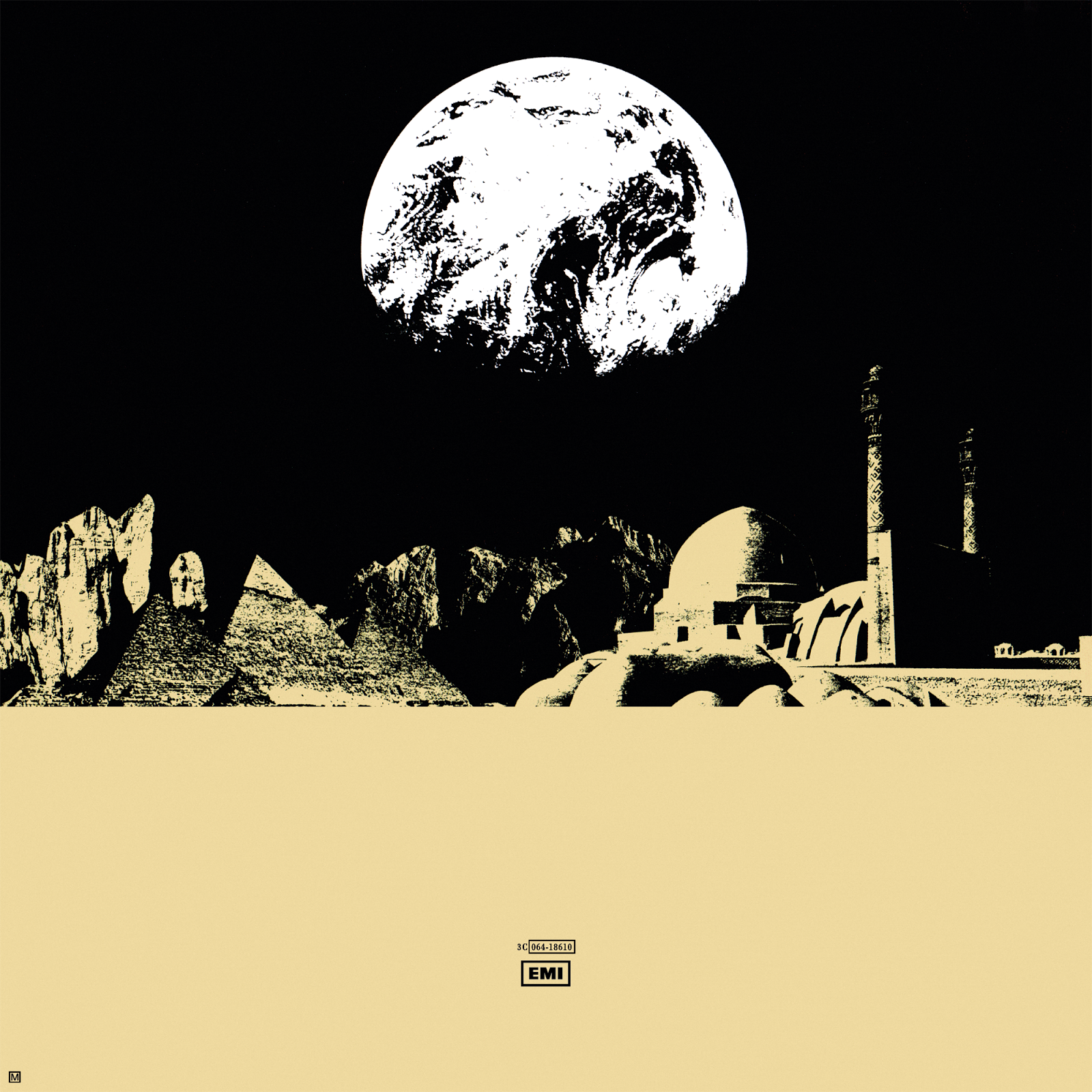
"Restoration", original innersleeve
In those years, always with Battiato, he wrote the music and arrangements of many hit songs for Italian singers Alice, Giuni Russo and Sibilla ("Per Elisa" by Alice won the Sanremo Festival in 1981, you can watch the original performance here), produced two albums for Milva and various songs for other artists.
In 1984 Pio, Battiato and lyricist Rosario 'Saro' Cosentino penned the Eurovision Song Contest entry "I treni di Tozeur", performed by Alice and Battiato, which finished 5th in the contest and became a considerable commercial success in Continental Europe and Scandinavia. A video of the original performance, which briefly shows Giusto Pio as orchestra conductor, is available here.
Between 1982 and 1987 he released three album of Pop music ("Legione straniera", which I already remastered some time ago, "Restoration", the subject of this post, and "Note"). In particular, "Legione straniera" and "Restoration", both written along with Battiato, sold very well and Pio became a well-known name among the younger audiences, as evidenced by the musical chronicles of those years on many magazines and newspapers.
In 1988 he published "Alla corte di Nefertiti", an album that marked the passage to a music style which was very different from his previous output and had far less commercial appeal. His association with Pop music definively waned after the end of his artistic fellowship with Battiato.
"Restoration", original innersleeve
Over the past decade, Pio increasingly approached acoustic and electronic research, and produced music for theater (for example the play "Medea", for the Florentine group Krypton, which won first prize for music at the Massa Carrara Festival, or his collaboration on Battiato's operas performed in the major Italian theaters), music for movies and interactive musical comments with other art forms such as painting, sculpture and poetry.
Among his most recent music releases we remember "Utopie" (1990), "Missa Populi" (dedicated to His Holiness John Paul II, 1995), and "Le vie dell'oro" (2000).
Giusto Pio has turned 90 on 11 January 2016; while searching updated information about him for this post I discovered that he has recently suffered a serious domestic accident. Let this be my biggest congratulations to the Maestro, and I'd also like to take this opportunity to offer him my most sincere wishes for a full recovery.
Franco Battiato and Giusto Pio, early '80s
"Restoration - The Ancient School of Restoration" contains the following tracks:
01. Gente a lavoro (4:01)
02. Happy Morning (3:40)
03. Radio Taxi (3:42)
04. Jour de Fête (3:46)
05. Rodolfo Valentino (3:16)
06. Passato e presente (3:27)
07. El Condor (3:10)
08. Restoration (3:40)
All tracks were remastered from the original vinyl in January 2016 and are available in FLAC lossless format, along with complete artwork reconstruction and printable PDF files.
Please have a look at the comments for the download link.
As I already mentioned in the previous post dedicated to Giusto Pio, the overwhelming success of Franco Battiato's "La voce del padrone", co-arranged by Pio - the first Italian album with a certified sale of more than 1.000.000 copies - finally led him to come out into the open with "Legione straniera", his first Instrumental Pop album:
«Working with Battiato in a confident and unbiased way without any preconceptions has helped me to see Pop in a different light. For example, I learned that some songs written by Paul McCartney were every bit as good as some of Schumann's work.» [1]
Recorded just one month earlier, "Restoration - The Ancient School of Restoration" was released by EMI Italiana with catalogue number 3C 064-18610 in March 1983; to date it has never been officially reissued on CD.
Once again, the album was produced by Angelo Carrara and co-written hand-in-hand by Pio and Battiato. Music, arrangements and stylistic features are quite similar to those contained on the LPs released by Battiato under his own name during the early '80.
Francesco Messina, Giusto Pio, Franco Battiato, Alberto Radius and Donato Scolese, circa 1981-82
«"Restoration" includes a few instrumental pieces composed by Franco (Battiato) and me; I also handled all the violin parts. It is mostly an album of Pop music, but it takes its title from a well known pavane by the French composer Gabriel Faurè that we reworked, as we had previously done with Bach, in our completely independent and peculiar way. In fact, when we registered it with SIAE (Italian collecting society for composers' copyrights) we presented both the original Faurè score and ours, so that the percentage of rights is shared between the heirs of the musician and us...» [2]
"Restoration" features the same team of musicians from the 'Battiato Factory' who already worked on "Legione straniera", including Paolo Donnarumma on bass, famous guitarist Alberto Radius and keyboardist Filippo Destrieri.
On this work Enzo 'Titti' Denna (...who probably engineered "Legione straniera" without being credited on the sleeve for an unknown reason...) also takes care of the Fairlight CMI programming, which is played by Destrieri. Compared to the previous release, "Restoration" sounds a bit more electronic to my ears, just like "L'arca di Noè" when compared to "La voce del padrone".
The elegant album cover, based on a drawing by Austrian painter Max Kurzweil, was designed by Francesco Messina «with the intention to 'paraphrase' the graphics of Deutsche Grammophon.» [3]
As already happened for the song "Legione straniera" the previous year, Battiato and Pio also took care of directing a promotional videoclip for the title track. Anyway, no song was issued as a single to 'drive' the album if we exclude this promotional item; I must admit that I don't remember having ever watched that clip then and unfortunately it hasn't resurfaced on YouTube yet... Anyway, you can watch a live performance of "Restoration" here.
One song from the album, "Rodolfo Valentino", was later given lyrics by Francesco Messina and released as a single by Italian singer Farida. Curiously enough, Giusto Pio was not credited as author on this release and Battiato appeared as Kui, one of his psudonyms... This version is available here.
Here's the complete credits and personnel list as translated from the back cover of "Restoration - The Ancient School of Restoration":
Music and arrangements by Franco Battiato and Giusto Pio.
Produced by Angelo Carrara.
Art Director: Francesco Messina
Music Publisher: Belriver s.r.l.
Front cover by Francesco Messina.
Drawing on front cover by Max Kurzweil.
Picture on back cover: Ilvio Gallo.
Keyboards: Filippo Destrieri
Drums: Alfredo Golino
Bass: Paolo Donnarumma
Guitars: Alberto Radius
Fairlight Computer (programming): Enzo 'Titti' Denna
Fairlight Computer (performing): Filippo Destrieri
Violins: Giusto Pio
Choir: Franco Battiato and Alberto Radius
Recorded at Radius Studio in February 1983.
Sound Engineer: Enzo 'Titti' Denna
Giusto Pio as he appears on the back cover of "Restoration"
The following clips offer a preview of the remastered album, please enjoy "Gente a lavoro", "Radio Taxi", "Rodolfo Valentino" and "Restoration"!
...and here's a live rendition of the title-track as performed in 1984 for an Italian television show; the audio sucks, but still is nice to see Mr. Pio and the band on stage!
More information about "Restoration - The Ancient School of Restoration", Giusto Pio and Franco Battiato is available here:
If you have any other useful information about this post or if you spot any dead links, please get in touch with me at stereocandies [at] hotmail [dot] com or leave a comment in the box below, thank you!