Showing posts with label Disco. Show all posts

Tuesday, 31 October 2017

DICK JENSEN "THE WRITER" (1979)

Oh me, oh me
I hate the morning after the night before
I know I can't take it anymore
I know I've said it once or twice before
I hate the morning after the night before

These bloodshot eyes now realize
those Mai Tais were the devil in disguise
If I could only find a way to stop this pile-driving pain
I promise that I'd never, ever, do it again
Do it again, do it again

Do it again, do it again
Go ahead, do it again

Oh me, oh me
I hate the morning after the night before
I know I can't take it anymore
I know I've said it once or twice before
I hate the morning after the night before

I feel the crutch of Planter's Punch
Martinis are no substitute for lunch
If I could only find a way to get this pain to leave my brain
I promise that I'd never, ever, do it again
Do it again, do it again
Do it again

Do it again, do it again
C'mon, do it again

Oh me, oh me
I should have just stayed in bed...


[from the lyrics of "I Hate the Morning (After the Night Before)"]


Here we are at last, very close to the end of the loooong series of posts I dedicated to Dick Jensen since October 2011. A lot of visitors of this blog have been requesting "The Writer" so many times, but two facts prevented me from offering it until now.

First of all I had to find a decent copy of the album and that hasn't been an easy task, believe me. This record is usually quite expensive on the second-hand market and most of the copies come with an autograph / dedication on the front or back cover, and the cover itself often suffer from ring wear...

At last, some three years ago I was lucky enough to purchase a sealed and untouched beautiful copy, but another factor delayed the publication of this post: my love/obsession for Chronology. If you're a recurring visitor of this blog I'm sure that you noticed that it is something I really care about and I always try my best to post according to that.

So, my apologies to all who have been requesting this album for so long: if you've been patient until now, I am sure that you will be satisfied with my digitization and remastering of such a precious gem.

Next in line in the following months will be the "Honolulu Girls / On the Beach" 7" single, which was released in the early '80s. I've always thought that it was the last Dick Jensen music release but I was wrong: only a few months ago I discovered with my greatest surprise that in 1985 he also released "True Spirit of Aloha", a religious album which is mentioned on a couple of Hawaiian websites.

Unfortunately I never had a chance to see a copy available for sale and I don't even know how the cover looks like... Since I am not a religious person I must admit that I am not particularly interested into it, but the parasitic completist that lives inside of me will never be satisfied until he's able to buy a copy. If you read these lines and can help him, I'll be glad to forward him your message... (8-)

Ok, enough said, here come the usual biographical notes. If you enjoy this post (...and the album...) don't forget to let me know about it in the comment section, thank you!


Jensen was a live musical performer of the Rhythm and Blues, Soul, and Gospel genres. A native Hawaiian athletic song stylist and a prime mover of nightclub shows inspired by Little Richard, whose "white hot soul" electrified audiences with his belting voice and imposing physical performances.

Jensen earned the sobriquet "The Giant" because of his tall stature, but he had a talent to match that nickname. His signature on-stage style incorporated strenuous dance moves similar to those of Jackie Wilson; he was noted for his glide - a proto-Moonwalk - well before Michael Jackson made it fashionable; just have a look at this clip on YouTube.

Jensen's music career began in 1959 and during the next fifteen years he moved back and forth between the Continental U.S. and Hawaii several times. He soon established himself as a singer in the Islands and in 1965 he got a contract with Loma Records.

During the late '60s / early '70 he often performed at several hotels and casinos and guested on many TV shows. His first album, entitled "White Hot Soul" (...available here...) was released in late 1969.

His potential as a national mainstream recording artist resulted in a contract with Philadelphia International, one of the top Soul music labels of the early 1970s. His "Dick Jensen" album was released in early 1973, but unfortunately sales were low and Jensen's tenure with the legendary label was very short...

For a detailed biography of Dick Jensen covering his career up till the early '70s please have a look at this other post of mine: "Dick Jensen - An Entertainer Without a Hit Record (Part 1, 1942-1972)".


Dick Jensen as he appears on the back cover of "The Writer"

Jensen returned to Honolulu around 1974 or 1975 and quickly re-estabilished himself as a local showroom star with engagements at the Hula Hut and at the Empire Room on the Oceania Floating Restaurant; the latter was jammed night after night for eight years.

Jensen's signature number, a fanciful comic story about the Lone Ranger and Tonto in which he single-handedly created all the voices and sound effects, was always a highlight, and every bit as impressive as his singing, dancing and overall showmanship... You can catch a glimpse of this performance - and much more - in the tribute video available on YouTube.

So, what do you do if you're a first class performer, you've written new songs but you find yourself without a recording contract? For some reason Jensen thought the best option was to self-release his own fresh material on a private label created on purpose, the evocative Record Club of Honolulu.

Produced and arranged by Don Costa for his Don Costa Productions Inc., "Giant of Hawaii" (...available here...) was released sometimes in mid/late 1976. Around the same time, a single containing two cuts from the album, namely a mono version of "Cloudy Mornin'" on Side A and a stereo version of "Love Shack" on the flipside, also appeared. The single, whish was probably aimed at radio promotion and rarely shows up for sale nowadays, is available here.

In 1978 Jensen had a small part in a TV movie entitled "The Islander". I desperately tried to find a copy of this movie or at least more information about it, but all I could come up with is this short synopsis.

During 1979 Jensen worked on a new album with Bartolome 'Bart' Bascone, a veteran Island musician, conductor, composer and arranger best known for his novelty song "Who Is the Lolo (Who Stole My Pakalolo)", which Don Ho recorded and made a radio hit in 1977. On a side note, Bascone also released two albums of his own compositions which are quite worth investigating... But now let's move on to "The Writer".


"The Writer" contains the following tracks:

01. I Hate the Morning (After the Night Before) (3:24)
02. You Keep Turning Me On (3:06)
03. Windward Lady (3:32)
04. Wanna Get in Your Pants (6:12)
05. Our Last Aloha (5:19)
06. Better Slow Down (3:28)
07. Lady Love (3:28)
08. Kong Chiki Kong (3:50)

All tracks were remastered from the original vinyl in October 2017 and are available in FLAC lossless format, along with complete artwork reconstruction and printable PDF files.

Please have a look at the comments for the download link.


"The Writer" was probably released sometimes in late 1979 on Giant Records, which I strongly suspect was nothing else but another one-off label created by Dick Jensen, just like the previous Record Club of Honolulu. I lean toward the late 1979 release date because on the spine is written "(C) 1979 Giant Records", even if the catalogue number assigned to this album is GRS 1980. My opinion is that the album was printed at the end of 1979 but it was given that catalogue number to make it look more fresh when it was first marketed during the next months.

The record comes in a sober black and white sleeve. Both on the front and back, Jensen is portrayed with an acoustic guitar, wearing comfortable light-coloured clothes and sandals. The image on the front cover gives a sense of calmness and looks like it was printed on a canvas; more probably it is not a photograph, but a sketch based on a photograph or something like that. In the picture on the back cover we notice that Jensen is wearing a medallion. It looks like a lion, but since he was born under the Aries sign it could also be a ram. Whatever it is, I guess it was much important to him since it can be seen in many other pictures that date back to the late '60s, a lucky charm maybe...

The cover is in deep contrast with the one featured three years earlier on the previous LP. Even the choice of the album title looks more meditative. The message that I perceive is that, due to the fact that at the time Jensen was widely acknowledged both as a singer and a performer, he also wanted to be recognised as an author. Of course this is my personal interpretation and I could be completely wrong. As a matter of fact, the album featured almost solely songs that he had written (seven out of eight) and this was happening for the first time in a long career.

Anyway, including a contagious Disco track and a few other lively Soul and Funk numbers, the album is not completely laid-back as the cover would suggest... Just like for the previous "Giant of Hawaii", most of the copies of "The Writer" that are usually put up for sale on eBay or similar websites are signed with a big marker by Jensen himself and often come with dedications. This undoubtedly means that most copies of the album were sold directly to people at his live shows as a souvenir of the performance: Jensen probably took the time to have a word with the audience and sign his records after the show...


Dick Jensen 1969/1979: the medallion is still the same...

Side 1 opens with "I Hate the Morning (After the Night Before)", whose lyrics you can read at the top of the post. It is a simple number but it is probably significant for what concerns Jensen's habits at the time. Almost two decades in the show-business were starting to take their toll and The Giant was caught in between the need to lead a quieter existence and the temptations of nightlife.

"You Keep Turning Me On" is one of the most fascinating tracks on the album, and a work of class for sure. The gentle percussion underlayer keep the rhythm moving, while the string machine creates a compelling atmosphere. The phased female backing vocal are just the icing on the cake and there's not a single note too much in this perfect piece, great!

We keep sailing along with "Windward Lady", another piece that wouldn't have made a poor showing on an album that Jensen could have released on Philadelphia International if they didn't decide to drop him. As I wrote elsewhere, I can only imagine what he could have done if only the label had kept on supporting him. Although Jensen's voice was not deep and smooth as Lou Rawls', his late '70s releases come to mind. Here's the lyrics to this beautiful song which I'm pretty sure Jensen dedicated to his wife at that time:

Windward lady, she's a special lady
and she never lets me down
Windward lady, she's a special lady
with both feet on the ground

We leave two lives so differently
me and my music, her and the family
She keeps them strong, I sing my songs
that lady does no wrong

Windward lady, she's a special lady
and she never lets me down
Windward lady, she's a special lady
with both feet on the ground

Some days we share with family and friends
breaking bread together again
After all it is said and done
she's still number one

Windward lady, she's a special lady
and the world should know
she's the one, she's the only one
and I love her, and I love her so
I love her so, I love her so

She's a windward lady, she's a special lady
she's a windward lady, she's a special lady


"Wanna Get in Your Pants", the last track on Side 1 seems to have been recorded - or at least mixed - in a completely different manner than the rest of the album. The original mix was almost mono compared to the other tracks and I had to invest a lot of energies and time to come up with a version that is more coherent with them. Maybe a 12" single has been taken in consideration at a certain point, who knows... Anyway, I guess that the title says it all, this is a commercial Disco affair with repetitive and explicit lyrics that also offers long instrumental parts and breaks.


Side 2 starts with "Our Last Aloha", which is the only song included on the album that was not penned by Jensen himself. The music and lyrics for this number were written by Bart Bascone, who also co-produced "The Writer". The song was originally included on Bascone's debut LP entitled "Makapuu", which nowadays has become such a rarity. Luckily enough, South Korean label Big Pink Music has re-issued the album on CD in 2013 and copies can still be found for a decent price. For his version, Jensen has slightly changed some lines and has also added a short rappin' à la Isaac Hayes... Here's the lyrics of this song:

Aloha means 'I love you'
Aloha also means 'Goodbye'

Baby, I lost it a long time ago
that love I had for you
but I found the courage to tell you how I feel
and say what is really real

Maybe I should have left you all by yourself
to settle your mind without me
Too many times I just followed you around
swallowed all the pride I had

Baby, this is our last aloha
this is our last goodbye
this is our last aloha
the feeling has finally died

I treasured everything about you
'cause loving you, loving you, is all I ever knew
But baby, you just kept pushing me away
pushing me, until all I have to say is goodbye

This is our last aloha
this is our last goodbye
this is our last aloha
the feeling has finally died

Aloha
goodbye, goodbye
the feeling has finally died

Oh, this is our last aloha
this is our last goodbye
this is our last aloha
that feeling has finally died

This is our last aloha
this is our last goodbye
this is our last aloha


The album proceeds with "Better Slow Down", a song which is arranged and played in an almost Funky manner, with slapped bass and Clavinet in the background, sort of... I am not sure if I got the lyrics' meaning right - Jensen's voice is not that clear in this piece - but it may be about not running too fast in a new relationship or the need of a breath of air during a sexual intercourse which might end too soon or... who knows!

Once again, with "Lady Love" I can't help but think about the albums that Lou Rawls cut with Philadelphia International during the same period that Jensen self-released "Giant of Hawaii" and "The Writer". There's no justice in this world... Interestingly enough, a song with the same title was recorded by Rawls himself a couple of years earlier, uhm... Could it be that Jensen was somehow inspired by Rawls' original? Who knows... and who cares, because this is another example of perfection and for sure one of my favourites from the album. One of the best songs that The Giant has ever recorded and produced during his career, full stop.

The album closes with "Kong Chiki Kong", a piece which - according to the original liner notes - was inspired by Sammy Davis, Jr. who was befriended by Jensen back in the days of his tenure in Vegas during the late '60s / early '70s. The song is an uptempo number which feature the only electric guitar solo on the album.

To end this post, here's the original credits and personnel list as they're printed on the back cover of "The Writer":

Music and words by Dick Jensen, except "Our Last Aloha" by Bart Bascone.

Musicians include:
Kata Maduli - bass
John Rapoza - guitar
Glenn Goto - keyboards
Mike Kennedy - drums
Vernon Kalama - percussions

(Backing vocals and horn section are uncredited...)

Produced by Dick Jensen.
Co-produced by Bart Bascone.

Thanks to Sammy Davis, Jr. for inspiring "Kong Chiki Kong" and to Don Costa for the thought.

Thanks to my lovely wife, Judy, for giving me my space to do this album.


The following clips offer a complete preview of the remastered album, enjoy!


More information about Dick Jensen is available here:

http://archives.starbulletin.com/2006/06/22/news/story02.html

http://the.honoluluadvertiser.com/article/2006/Jun/22/il/FP606220304.html

https://web.archive.org/web/20150905205717/http://www.oahuislandnews.com/May05/Home.htm

http://en.wikipedia.org/wiki/Dick_Jensen

I'm currently compiling a Dick Jensen biography, the first part of this work-in-progress covers the period 1942-1972 and is available here.

I'm also trying to compile a Dick Jensen exhaustive discography, my work-in-progress is available here.

Last but not least, I'm also trying to build a collection of Dick Jensen pictures and memorabilia, my work-in-progress is available here.

All my posts dedicated to Dick Jensen on this blog are available here.


If you have any other useful information about this post, or if you spot any dead links, please get in touch with me at stereocandies [at] hotmail [dot] com or leave a comment in the box below, thank you!


Wednesday, 27 September 2017

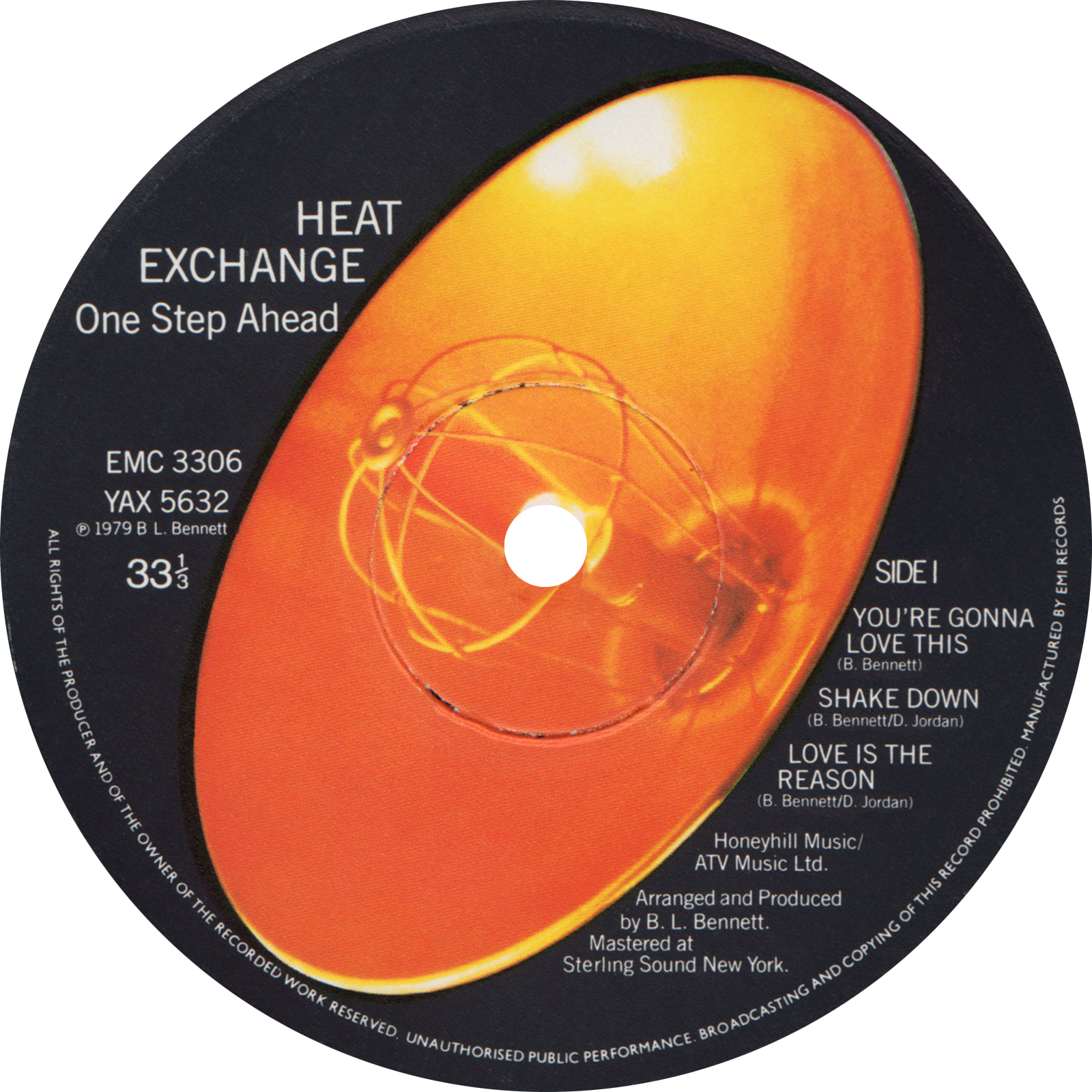
HEAT EXCHANGE "ONE STEP AHEAD" (1979)


Brian Lawrence Bennett was born in Palmers Green, North London, on February 8th, 1940. His interest in music dated from an early age, and as a small child he used to listen to radio broadcasts from the Aeolian Hall. Soon he was hooked on the sounds of Glenn Miller and the other Big Bands of the era.

He became fascinated by drums and percussion and lists Gene Krupa, Louis Bellson and, especially, Buddy Rich as his early musical heroes. By 1953, Brian had saved up enough money to purchase a rudimentary drumkit and he practiced constantly. Before long he was performing regularly with his school orchestra and youth club big bands.

He began playing professionally even before he left school, with his own Tony Brian Trio and The Esquires Dance Band. He also began composing music and writing songs from the age of fourteen onwards.

Brian's initial background was in Jazz and Swing, but by 1956 - the year he left school at sixteen to play drums in a Ramsgate skiffle group performing for holiday makers - he was equally adept at playing Rock'n'Roll. «It wasn't originally by choice», recalled Brian, «but there were more and more jobs being offered and I didn't want to turn them down!».

A teenage prodigy, he became the house drummer at the legendary 2i's Cofee Bar - now known as the birthplace of British Rock'n'Roll - in London's Soho, backing artists like Tony Sheridan, Terry Dene, Vince Eager and Vince Taylor, and from there he earned a regular spot on the Jack Good's legendary TV music showcase Oh Boy!.

By 1959, Bennett was regarded as one of the top Rock & Roll drummers in England and one of the most sought-after percussionists around. That year he joined The Wildcats, the backing band of Rock & Roll singer Marty Wilde. He remained with Wilde for two years, also playing outside live gigs with stars such as Tommy Steele, and in 1960 he embarked on the legendary tour featuring Eddie Cochran, Gene Vincent and Marty Wilde.

When Marty embarked upon a career in films and musicals, The Wildcats evolved into The Krew Kats and cut a brace of fine instrumentals, including a stunning version of Chet Atkins' "Trambone". After a brief stint as an orchestral pit drummer, in October of 1961 lightning struck for Bennett's career when Tony Meehan - then regarded as the top drummer in England - quit The Shadows, who were then the top Rock & Roll British band as well as the backing group for Cliff Richard, the top singer in the field.


The opening was one of the most coveted in the country - The Shadows were regularly topping the charts in their own right, and their concerts with Richard were riotous affairs, huge sell-outs in front of hordes of screaming fans across England - Bennett was offered the spot. He accepted and was with the group across a string of hit singles and albums, lasting through their intended official breakup in 1968, on the occasion of the group's tenth anniversary as a professional band.

His drumming talents were but one aspect of his monumental musical contribution to the band. He wrote or co-wrote over 100 tracks for them, as well as over 20 compositions for Cliff Richard... He also earned his first Ivor Novello award for composing the title theme to the movie "Summer Holiday", which starred Richard and the band - he also contributed songs to their subsequent movies, up through "Finders Keepers".

A favourite feature for the audience at any Shadows' concert was always his drum solo, with "Little B" - a must showcase for every Beat-Drummer in the pre-Beatles era - perhaps being the best known and highly regarded piece which has inspired countless drummers over the years and is still performed now by budding young drummers at Shadows' music clubs throughout the U.K.

Many drummers back then considered each new Shadows' record as a drum lesson - learning how to play the fills in classic tunes such as "The Rise and Fall of Flingel Bunt" and "Foot Tapper".

In 1967 Bennett released his first solo LP exploring Jazz and Easy Listening territories with the aptly entitled "Change of Direction", which was followed in 1969 by "The Illustrated London Noise", a return to Rock and Funky music.

Following the 1968 "farewell" Shadows concert, he participated along with lead guitarist Hank Marvin and bassist John Rostill in the band's brief 1969 reunion for a tour of Japan.

By the early '70s Brian was a highly successful and much sought after session drummer working with a vast array of different artists including Ella Fitzgerald, Olivia Newton-John, Engelbert Humperdinck, Richard Harris, The Walker Brothers and many more.

With The Shadows on extended hiatus, Bennett turned to other areas of music. He'd already developed some insights into the mechanics of music through his work as a songwriter, and he took a correspondence course in arranging and orchestration that, when added to his natural ability as a composer, ended up reshaping his whole career. He'd always provided vocals on the Shadows' own recordings, and now he re-established his performing credentials on the piano as well as the vibraphone.

He became Cliff Richard's musical director and formed The Brian Bennett Orchestra touring the world including the first Western rock concerts performed in Russia. Even more important, amid the string of hit albums with Richard that followed, he also started writing music for movies / television and part of this huge load of work was published on many library records by specialized labels like KPM Music and Bruton Music.


Brian Bennett in his studio, circa late '70s

In 1977 he published his third proper solo album, "Rock Dreams", available here and credited to the Brian Bennett Band, which was followed the next year by "Voyage - A Journey Into Discoid Funk", a Disco/Funk opus that was recently remastered and re-released on vinyl and digital download. 1979 was also a busy year for Bennett, who was commissioned a Disco album by EMI; the result was "One Step Ahead", the subject of this post, credited to the Heat Exchange project.

Later on, Brian developed yet another career composing music for films. During the '80s, he was awarded his second Ivor Novello award (for 25 years services to music) and wrote music for a wide range of programmes including "Dallas", "Knotts Landing", "Pulaski", The Royal Wedding of Prince Charles and Lady Diana Spencer (!!!), the "BBC Golf" theme, "The Sweeney", Dennis Hopper's film "The American Way" and Ellen Barkin and David MacCallum's "Terminal Choice". In 1990, he won his third Ivor Novello award for Best Score For a Television Series (The Ruth Rendell Mysteries).

From the 1990s to 2000, he was in demand more than ever and he composed music for the long-running series "The Knock", "Nomads of the Wind", "Global Sunrise", "Living Britain", "Dirty Work", "David Jason In His Element" and Hansjörg Thurn's film "The Arpist".

In 2001 Bennett was the proud recipient of the Gold Badge Award given by the British Academy of Songwriters, Composers and Authors. He also won the Royal Television Society Craft & Design Awards 2000/2001 for Best Original Title Music for "Murder In Mind". In 2004 he was awarded an OBE and collected his award from The Queen at Buckingham Palace.

In 2009 and 2010 Cliff Richard and The Shadows embarked on a 50th anniversary tour with 36 shows in the U.K., Europe, Australia, New Zealand and South Africa. More recently, Bennett wrote with his son, Warren, 24 episodes of the award-winning TV series "New Tricks". He also recorded and produced an album with Cliff Richard and The Shadows.

In 2015 he worked on a musical called "Soho" and the music for a production called "Starchild". His latest album, entitled "Shadowing John Barry - New Recordings for Guitar and Orchestra", was released in February 2016... Although he will always be associated with The Shadows, playing drums for them is merely one aspect of a glittering musical career.


"One Step Ahead" contains the following tracks:

01. You're Gonna Love This (7:07)
02. Shake Down (6:55)
03. Love Is the Reason (7:58)
04. One Step Ahead (6:25)
05. Check It Out (5:52)
06. Lost On You (7:04)

All tracks were remastered from the original vinyl and CD re-issue in September 2017 and are available in FLAC lossless format, along with complete artwork reconstruction and printable PDF files.

As usual, please have a look at the comments for the download links.


"One Step Ahead" was released in the U.K. by EMI with cat. number EMC 3306 sometimes in 1977. The album was also released on cassette with cat. number TC-EMC 3306 and spawned a 12" single that featured "Shake Down" b/w "You're Gonna Love This" (12EMI 2988); edited versions of the same tracks were also released as a 7" single (EMI 2988).

In 1994, the album was re-released on CD by See For Miles Records under their C-Five Records inprint. The booklet offers precious information about Bennett and the album. The original notes were compiled by Rob Bradford, the following is a slightly edited and updated version:

«In 1985 Brian Bennett was delighted when he was commissioned to provide the complete score for the film "Terminal Choice". «Basically», he remarks, «I got that job because it was financed and set up in America. To the Americans, I was just another composer and they judged my music purely on its own merits. That was great. No preconceptions, you see? The majority of Americans have never even heard of The Shadows». In conversation it's a theme he returns to over and over again. The dangers of being musically typecast or pigeonholed. He cites many instances where he feels that his music has been dismissed as out of hand. Something along the lines of: "Brian Bennett? Isn't he The Shadows' drummer? We're looking for a musician, a composer - not a drummer!" In actual fact, playing drums for The Shadows for almost thirty years is only one facet of Brian's immense musical talent. His contribution to The Shadows was monumental and he will always, inevitably, be associated with them. However, Brian's other musical ventures have been both numerous and varied and his output of music as a composer has been truly prodigious.

Brian was always much more than just a beat group drummer. He studied the violin and musical theory for many years and successfully completed a course on orchestral arranging. In 1967 he released "Change of Direction", thus making him the first Shad to release a solo album. It was to be the first of many such projects. During the '70s Brian became a top session drummer as well as beginning his prolific output of library, TV and film music.

Heat Exchange was a commission that Brian undertook in 1979. He'd heard that EMI were looking for an album in the style of the then current Funk / Disco craze. «It all sprang from the New York club scene,» recalls Brian, «The Bee Gees struck lucky with "Saturday Night Fever" and then everyone went disco crazy. But one of the true originators was a guy called Sylvester. He was my starting point.» Sylvester James, Jr. was the doyen of disco music singers; his biggest hits were "You Make Me Feel (Mighty Real)" and "Dance (Disco Heat)".


As ever, Brian assembled a talented team of musicians including: Rickie Hitchcock (guitar), Les Hurdle (bass) and Mike Moran (keyboards). The vocalist we are not at liberty to divulge. I can tell you that he was British and has had chart success in his own right... «Guaranteed anonynimity was one of the conditions he insisted upon. He only did it as a one-off, for the money. But, I have to say that he was utterly brilliant. I've a feeling that Cliff Hall was on some tracks as well. For "Shake Down", I got Chris Lawrence to play the bass line. He had a genuine, groovy, pumping funk-disco style. I'm no lyricist. I enlisted a guy called Dave Jordan. He and I were on the staff of ATV music. He was someone I knew from weekly team meetings. I also had a brass section on there. I was thinking of stuff like Earth, Wind & Fire... Isaac Hayes and so on. I'd go over the scores with them... make suggestions... while we were all sitting around with drinks. All very relaxed. I wanted a party atmosphere. Then, they'd just cut it... live in the studio... hit a groove. I was delighted with it. When the whole thing was completed, I took it to Stirling Sound Studios in Manhattan to get it cut and mastered, to achieve that big 'Tuff' sound. Another thing that's worth mentioning is that all the drumming and percussion is yours truly. By that I mean that there are no drum machines, drum boxes, samplers, synth drums or whatever. No effects at all.»

It certainly does sound remarkably authentic. So authentic that it would have surely been chart material if given to a 'name' disco act to cover. This wasn't pastiche, it was Brian composing in a definite style. I asked Brian if he was pleased with the end product, particularly with regard to its authentic Disco style. «I was quite pleased with it. As a composer, you should be able to adapt to any particular style. Very few people realised it was me. It had the words 'Produced by B.L. Bennett' somewhere on the sleeve, in very small print. That was deliberate. The reviews were great in that they said things like... 'A tight set obviously recorded by top New York session men.' Great. It just goes to show that some critics don't know who they're listening to, or what they're talking about!»


"One Step Ahead", original rejected front cover artwork reconstruction


My copy of the album contains some notes - handwritten by the previous owner on the Side 2 center label - about the musicians featured on the recordings. Some of them are confirmed by Bennett himself in the interview that is quoted on the 1994 CD re-release; unfortunately the name of the singer remains a mystery... The picture above is based upon a tiny image included on the booklet of the aforementioned CD album.

Here's the credits and personnel list of "One Step Ahead":

Les Hurdle: bass
Chris Lawrence: bass on "Shake Down"
Rickie Hitchcock: guitar
Mike Moran: keyboards
Cliff Hall: additional keyboards
Dave Lawson: additional keyboards
Frank Ricotti: percussion
Brian Bennett: drums
Vicky Brown: backing vocals

All songs by Brian Bennett, except "Lost On You" written by Brian Bennett and Warren Bennett.

Lyrics on "Shake Down", "Love Is the Reason" and "Check It Out" by Dave Jordan.

Arranged and produced by Brian Lawrence Bennett.

Mastered at Sterling Sound, New York.


Brian Bennett playing drums


The following clips offer a complete preview of the remastered album, enjoy!


More information about Brian Bennett is available here:

https://www.discogs.com/artist/516363-Heat-Exchange

https://www.discogs.com/Heat-Exchange-One-Step-Ahead/master/617375

https://www.discogs.com/artist/108870-Brian-Bennett

https://rateyourmusic.com/artist/brian_bennett

http://en.wikipedia.org/wiki/Brian_Bennett_%28musician%29

http://www.brianbennettmusic.co.uk/

https://www.youtube.com/watch?v=_p671Y__w8U

http://www.mikedolbear.co.uk/story.asp?StoryID=1449

http://www.drummerworld.com/drummers/Brian_Bennett.html

http://www.allmusic.com/artist/brian-bennett-mn0000621102

http://www.whosampled.com/Brian-Bennett/sampled/?sp=1


If you have any other useful information about Brian Bennett, Heat Exchange and "One Step Ahead" - especially corrections and improvements to this post - or if you spot any dead links, please get in touch with me at stereocandies [at] hotmail [dot] com or leave a comment in the box below, thank you!

Monday, 31 August 2015

EXPORTATIONS "MEET THE EXPORTATIONS" (1978)

Once you were in love with me
There was no-one else that you wanted to see
But now that you've gone all I do is cry
Once I was the apple of your eye

Because I fell in love too late
There's no correcting my mistake
Time wasn't on my side, hey baby
Because I fell in love too late
There's no correcting my mistake

Now that I'm in love in with you
You say there's nothing that you can do
But my love for you grows each passing day
And girl, oh girl, I've got to find me a way

That special feeling that you had is gone
And like a fool I sit all alone
For the love, for the love that we could have had
Oh girl I know that I need it so bad

Now, when I had you, I just let you slip away from me, baby
Girl, you see, time wasn't on my side
But I feel in love, in love, in love
Can I say, can I say, can I say, that we can start all over again
Too late, too late to apologize, I need you baby right by my side...


[from the lyrics of "Fell In Love Too Late"]


My friends, I've been delaying this post for about two months hoping that I would be able to find a little bit more information about the Exportations, the lovely vocal group from Detroit that is featured today. Unfortunately, I wasn't successful and this time you'll have to enjoy the music with just a few accompanying words...

Let's start from the elusive liner notes written by Clarence "Foody" Rome Jr. of W.C.H.B. Radio 110 AM that appear on the back cover of "Meet the Exportations":

«I've known The Exportations for four years now, but those of you who don't know them let me take time to introduce them to you. The Exportations is a Five member group with three brothers (The Gibson Brothers) Arthur (Rick), Willie (Crick) and Bernard (Bee), also there is Anthony Pilgrim (Amp) and Lucian Thomas (Sonny). Ladies and gentleman you have just met the Exportations and we truly hope you'll enjoy this LP for it is a first, but not the last. Once you have heard this album you'll agree The Exportations sing with close tight harmony and feeling. As you know we could go on and on but I'll let you judge for yourself. While enjoying this album keep these thoughts in mind. Sometimes words can't express feelings but it all comes out in a song. After it's all said and done we couldn't have done it at all without the help of the Lord above.»


Well, at least now we know the name of the five members of the group and we can play a little game: Give every face a name... I bet my luck that the three Gibson brothers are - on the front cover, from the left - the first, the second and the fourth guy, what do you think? It would be way too long to explain how I came up with this conclusion, but I believe that Bernard Gibson is the second guy from the left... Now, seriously, maybe there is someone out there who can match the faces with the names...? Let's get in touch if that is the case, thanks!

According to Jimmy Anderson, who wrote songs for the group and also managed them, all the five members could lead-sing, and Exportations toured nine countries in Europe sometimes during the late'70s or early '80s.

"Meet the Exportations" is the only album that the group recorded. During the '80s it was followed by four singles, most of which are rare - and quite expensive! - nowadays.

Here's the short list:

- "Find Another Day" b/w "I Want You", VIR-RO Records, EXP 1001, 7", 1980

- "Easy Come, Easy Go" b/w "You Did It", VIR-RO Records, VR-001, 7", 1981

- "Party Down (Vocal)" b/w "Party Down (Instrumental)", Birdie Records, BD-1003, 12", 1982

- "Find Another Day (Vocal)" / "Find Another Day (Instrumental)"b/w "Find Another Day (Fresh Mix)", Spectrum X Records, SPX 404, 12", 1986


"Meet the Exportations" original inner sleeve shows United Artists goodies of 1978...

During the mid '80s, the Exportations changed their name to Living Proof and enjoyed a few 12" releases which culminated in their only album (...again...), which was published in 1989 by G.E.M.C. Records; this will be the subject of a future post here on Stereo Candies.

Here's the complete list of Living Proof's output:

- "Hold On To Your Dreams" b/w the same track, Fantasy Records, Fantasy 977, 7" promo, 1986

- "Hold On To Your Dreams" b/w "You Can Make It If You Try", Fantasy Records, D-278, 12", 1986

- "Hold On To Your Dreams" b/w "You Can Make It If You Try", Marquee Records, MQ 100, 12", 1986

- "You're the Apple of My Eye" b/w "You're the Apple of My Eye (Radio Edit)", G.E.M.C. Records, 12-PO18, 12", 1988

- "Where Did I Go Wrong" b/w "Where Did I Go Wrong (Radio Edit)" / "Where Did I Go Wrong (Instrumental)", G.E.M.C. Records, 12-PO29, 12", 1989

- "Living Proof", G.E.M.C. Records, GEM 4002, LP/CD with 8 tracks, 1989

According to this page, during the years Bernard Gibson was also briefly involved with the Five Special and The Floaters; he toured with The Jackson Five and Jeffrey Osborne, and later became a member of the Dennis Edwards Temptations Review for sixteen years.

I truly don't know what happened to the rest of the group; after months of research the Exportations remain almost a black hole for me...


...the warmth of music brights up a cloudy day, sort of...


"Meet the Exportations" contains the following tracks:

01. Strange Sensations (4:14)
02. Fell In Love Too Late (5:31)
03. Kiss Me Love (5:07)
04. Main Ingredient (3:33)
05. You've Been a Long Time Coming (8:19)
06. Music (6:52)
07. Strange Sensations (Instrumental) (4:09)

All tracks were remastered from vinyl in June 2015 and are available in FLAC lossless format or high-quality 320 Kbps MP3 files. Both formats offer complete printable PDF artwork.

Please have a look at the comments for the download links.


"Meet the Exportations" was released sometimes in 1978 by United Artists with cat. number UA-LA872-H. No singles were excerpted from the album, except a promo version of "Strange Sensations" which contains a mono version of the track on Side A and a stereo version on Side B.

I guess that the album wasn't supported or promoted very much by the label and it probably didn't sell well; most of the copies that are available for sale nowadays have a cut corner and we all know what this means...

Side A starts with "Strange Sensations", a track written by producer Clarence W. Rome, Jr.; the song has a nice arrangement and is a fine way to begin an album. The group show off their individual features and it would be interesting to know who's singing what, the falsetto, the tenor, the harmonies, etc.

"I Fell In Love Too Late" is one of my favourite tracks from the album, and the only one whose lyrics I was able to decipher in their entirety. The song was written, once again, by Rome along with bassist Alfred Boyd, Stephen Nathaniel Pettis and Eugene Pettis; the harmonies on this piece are particularly effective and I guess it's no coincidence that the song was recycled on the Living Proof album in 1989.

With the faster "Kiss Me Love", we enter in a more Funky territory. Just like the previous number, this piece was written by Rome with Boyd and the two Pettis. The second half of the song has a long instrumental section and I'd like to give a particular mention to the arrangement which succeed in keeping the track busy without making it overcrowded.

First side closes with "Main Ingredient", another slow song written by the band's manager, Jimmy Anderson, along with Soul singer and songwriter Tyrone Pickens of Tony & Tyrone fame.

Side B starts with the veeery long (...more than eight minutes...) "You've Been a Long Time Coming", another piece written by the Rome / Pettis / Boyd / Pettis team. The song begin with a relaxed intro but soon changes direction to almost reach the Disco dancefloor. The refrain stucks in your head and you can't help to wonder why this song wasn't released as a single...

"Music", written by producer Clarence W. Rome, Jr. alone, is for sure the funkiest track on the album. Its repetitive structure only allows a couple of breaks and includes the usual chit-chat as found in other more famous songs, for example the full version of The Intruders' "I'll Always Love My Mama" or the beginning of Isaac Hayes' "Juicy Fruit (Disco Freak)".

The album ends with an instrumental version of "Strange Sensations" which doesn't suffer much from the lack of vocals.


Here's the complete credits and personnel list of "Meet the Exportations" as they appear on the back sleeve:

Exportations are:
Arthur "Rick" Gibson
Willie "Crick" Gibson
Bernard "Bee" Gibson
Anthony "Amp" Pilgrim
Lucian "Sonny" Thomas

Dave Davidson: lead and rhythm guitar
Willie Hollis: keyboards, piano and Clavinet
Tony Longgrear: bass
Norman Perry: drums
Butch Lomax: drums

Wendell Spencer: string synthesizer and Clavinet
Jimmy McKee: Clavinet
Dennis Addison: congas
Clarence W. Rome, Jr.: congas and bongos

Art director: Bill Burks
Album design: Earl Klasky and Jeff Lancaster
Photography: Houser D'Orio

Rhythm arrangement by Foverro and Dave Davidson.
Rhythm arrangement on "Strange Sensations" and "Music" by Foverro.
Horns arrangement by Jimmy McKee, Foverro and Harold Jones.
Horns arrangement on "Strange Sensations" by Jimmy Roach.

Mixing and recording engineers: Mike Grace and Mark Calice
Recorded and mixed at The Sound Suite, Detroit, Michigan.

Produced by Clarence (Foody) Rome, Jr., for Foverro Productions.

Special thanks to all the Sound Suite Gang, John, Mike, Karen and Mark, Major Anthony, Jack, Pat and Spencer, Mike Stokes.

God bless Mrs. Lillie Mae Gibson, Mrs. Lenore Pilgrim and Mrs. Kathryn Thomas, our mothers, for their strenght, guidance and prayers.

Right on to Al (Perk) Perkins for his help and encouragement.

Special thanks to Masai Karega Kenyatta (Fred Goree) of W.C.H.B. Radio 1440 AM, Detroit, Michigan, for his very much accepted advice and idea for the song "Main Ingredient".


The following clips offer a preview of the remastered album, enjoy "Fell In Love Too Late", "Kiss Me Love", "Main Ingredient" and "You've Been a Long Time Coming"!


More information about the Exportations and Living Proof is available here:

http://www.discogs.com/artist/1380950-Exportations

http://funk-o-logy.com/forum/viewtopic.php?f=49&t=5831

http://souldennis.blogspot.com/2013/07/an-interview-with-jimmy-anderson-aka.html

http://seesaawiki.jp/w/golden_age_of_soul/d/The%20Exportations

http://blog.livedoor.jp/adhista/archives/1544299.html

http://blog.livedoor.jp/adhista/archives/1545696.html

http://soulful.cocolog-nifty.com/soulog/2009/07/the-exportation.html

http://www.discogs.com/artist/990762-Living-Proof-3

http://seesaawiki.jp/w/golden_age_of_soul/d/Living%20Proof?wiki_id=39060

http://soulful.cocolog-nifty.com/soulog/2009/07/living-proof-li.html

http://blog.livedoor.jp/adhista/archives/1544295.html

http://blog.livedoor.jp/samny/archives/51977408.html

http://www.discogs.com/artist/652873-Bernard-Gibson

http://www.discogs.com/artist/445432-Rick-Gibson

http://reedmusic.wix.com/magic-of-motown#!music/c1x9v

http://www.discogs.com/label/324743-The-Sound-Suite-Detroit


If you have any other useful information about this post, or if you spot any dead links, just get in touch with me at stereocandies [at] hotmail [dot] com or leave a comment in the box below, thank you!
Saturday, 14 February 2015

AMBO QUAERENS "AMBO QUAERENS" (1980)

«Among all the experiments that are taking place in modern music, maybe the Miami-based French duo of Phil Lasry and Franck Lasry is the one that has most impressed the medias. Featuring voices that position them out of the ordinary, we believe that it is well worth listening to this LP carefully, because it has much to contribute to the current world of musical innovations.»

[Translated from the original Spanish press-release of "Ambo Quaerens"]


Front cover features a picture of Philippe G. Lasry a.k.a. Phil Dufix...

Well, I've been delaying this post for a while trying to find some information about Ambo Quaerens and their self-titled album, but it looks like this time I will be forced to keep it short because I almost didn't find any: no pictures except those of the album cover, not a single video on YouTube - well, that was until I uploaded four songs last week - and, what's worse than anything else, not even a three-lines biography, N-O-T-H-I-N-G.

If you've visited this blog in the past, I am sure that you've noticed how I like to provide detailed information about each release that I take care of, and not being able to do so this time makes me a little bit sad... OK, let me dry my tears and begin...


...back cover offers the usual track titles and brief notes...

As indicated in the brief liner-notes on the back cover, the album was "written, composed, conducted and produced by Phil & Franck G. Lasry for Miami Trans Music". The Ambo Quaerens page on Discogs.com was quite helpful to trace a sort of family tree of the two Frenchmen (...brothers? Cousins? Homonymous?) which were members of the band.

It looks like Philippe Guttières-Lasry also used the Phil Dufix alias for "Heroes", a cult Disco LP released in 1980, the same year that the Italian edition of "Ambo Quaerens" was published. At first sight, the long-haired blond guy portrayed on the cover picture of "Heroes" seems to have little in common with the cover-star of "Ambo Quaerens", but if you carefully compare the two pictures then you'll start to notice they share some features.


...the outer right panel features a picture of Franck G. Lasry for good measure...

Phil was also responsible for Texico, the one-album Disco project that brought us, ehm, "Texico" in 1977... And just for the record, no matter how hard I try but I can't see him on the cover this time, no, no, no... To complete the "one-album project saga", in 1982 he also released "Nervios" under the Wox moniker; hope I will be able to dedicate a post to this album in the future.

Franck Guttières-Lasry, also known as Franck Val, was involved in the Wox project too, and according to Discogs he was also in charge of mastering / mixing a few releases during the early '80s. His picture was placed on the outer right panel of the lavish and elaborate triple gatefold sleeve of "Ambo Quaerens"; more about this subject a few lines below...


...and an Ambo Quarens logo graces the inner center panel of the triple gatefold sleeve.


"Ambo Quaerens" contains the following tracks:

01. Fugitive Rendez-vous (3:21)
02. Facility (5:10)
03. Stop Crying (3:00)
04. Can't Forget (5:24)
05. Risk (4:36)
06. I Wanna Trust (4:08)
07. How About (4:14)
08. Fairy Tail (3:09)

All tracks were remastered from the original vinyl in February 2015 and are available in FLAC lossless format or high-quality 320 Kbps MP3 files. Both formats offer complete printable PDF artwork.

Please have a look at the comments for the download links.


This is how the triple gatefold sleeve looks when open...

The first edition of "Ambo Quaerens" was released in Italy by WEA in 1980. As mentioned before, the album features an elaborate triple gatefold sleeve, or as someone would better explain, a gimmix cover: the front cover and the outer right panel are both cut in seven horizontal stripes, so that the faces of Phil and Franck can be combined together; here you can see an example. The artwork was created by famous French photographer and director Jean-Baptiste Mondino.

My copy of the album is a promo version of the Spanish edition that was released by Zafiro in 1981. The main difference between the two editions is the following: the front cover and the outer right panel are cut in two big horizontal slices only, and the "combined faces" effect is almost lost...


Side One opens with the reverberated piano notes of "Fugitive Rendez-vous", which is one of the strongest cuts of the album. Both Phil and Franck sing on this tune - and on some of the other tracks too - but unfortunately I don't know which of the two voices belongs to each of them and, believe me, I would be quite curious to learn who is the fragile falsetto.

Soon follows "Facility", another lovely and catchy tune that probably would have benefited from a promotional videoclip in those days of New Romanticism. In 1980 the song was released as a promo 12" single for Italian radio stations backed with "Risk" on the flipside, but was moved to Side B on the official 7" that was released the next year.

With "Stop Crying" we enter in a sort of "La Boum" territory (...does anyone here remember about it?) and I'm sure that this song wouldn't have looked bad in the movie or in a similar movie... This piece is sung by the falsetto voice alone, which it is stretched to its limits and way beyond... However I love this album, in my opinion this is its weakest point.

After this misstep, the synth textures, string machine and Disco hints of "Can't Forget" definitively brings quality back: if my ears did not deceive me, the sounds and the atmosphere of this piece resemble some of the tracks that Duran Duran will record and release just one or two years later... And by the way, the falsetto voice is absent on this song...


...and here we are, at last, on Side Two, ready for the piano chords that introduce "Risk", the band's opus and for sure the highest point on the album. When I listen to this tune, I really can't help myself to hum, sing and shout! How is it possibile that Ambo Quaerens almost didn't left a trace of their brief passage? And returning to what I wrote at the beginning of this post: why the lack of information about them? Phil and Franck, I truly hope that you're still out there and fine, I'd like to thank you for this beautiful song: it still sends shivers on my back 35 years after the first time I listened to it!!!

By the way, is there any mother tongue English / American visitor of this blog who would be so kind to decipher the lyrics of this song for me? I desperately tried, but most of my efforts were useless... It would be great if someone could help, THANKS!

OK, I recompose myself just to add that in 1981 the song was relased as a 7" single both in Spain (...with "How About" on the flipside) and in Italy (...with "Facility") where it was also used as the theme song for a sexy television show entitled "Playboy di sera" (Playboy By Night).

"I Wanna Trust" is the most Pop-Rock oriented song of the lot and it features a prominent guitar sound with many solos... A radio-friendly piece for the American market? Uhm... Not bad, but a little bit anonymous... "How About" brings back a Disco beat with additional percussions, falsetto singing and a catchy refrain; definitely the most danceable song on the album.

All good things come to an end, and this is no exception of course: "Fairy Tail" (...a wordplay or a mistake?) is an instrumental number, mainly for piano and strings, that - like a few other passages and solutions heard in some of the previous tracks - seems to betray a classical music education. Just a guess, who knows...


...and this is the inner view of the triple gatefold sleeve when open.


The following clips offer a preview of the remastered album: enjoy "Fugitive Rendez-vous", "Facility", the masterpiece "Risk" and "Can't Forget"!


A few more information about Ambo Quaerens is available here:

http://www.discogs.com/artist/1819849-Ambo-Quaerens

...not many links this time, uh? Well, as a bonus, here's the original press-release included in the Spanish edition of the album:


If you have any other useful information about Ambo Quaerens - especially corrections and improvements to this post - or if you spot any dead links, please get in touch with me at stereocandies [at] hotmail [dot] com or leave a comment in the box below, thank you!

Related Posts Plugin for WordPress, Blogger...