Best known as a member of I Gufi (The Owls) - an Italian musical and comedy ensamble - actor, singer, comedian and writer Roberto Brivio was born in Milan in February 1938.
Son of a man from the Brianza area and a Friulian woman, he dedicated himself to theatre after graduating with famous actress Esperia Sperani, from the Accademia dei Filodrammatici, in 1959.
At the beginning of the '60s he joined the Compagnia dei ragazzi dell'Angelicum and started producing a series of 7" singles for children and prose LPs for La Voce del Padrone and Ricordi.
Among these we'd like to remember at least his Italian adaption of Nigel Kneale's "The Quatermass Xperiment" (L'astronave del Dottor Quatermass), which will hopefully be the subject of another post here on Stereo Candies in the future.
In 1962 he opened the Teatro del Corso in Milan, which he successfully managed for a few years.
Around the same time he started writing for the Italian TV and radio, and also produced his first comedy / chanson records for the Columbia label under the alias Roberto Bi. These included some early examples of his gallows humor, which he will expand later on during his experience with I Gufi.
In 1964, the meeting with Lino Patruno and Nanni Svampa, later joined by Gianni Magni, gave rise to the aforementioned musical group. In those years, I Gufi helped to create a form of musical cabaret in Italy, often using the Milanese dialect in their productions.
Their debut album, entitled "Milano canta" (Milan Sings), was released by Columbia in February 1965, and was the first in an astounding series of twelve successful LPs which were produced by the group in just four years.
During his tenure with I Gufi, Brivio was credited for writing about 50% of the band's repertoire in collaboration with his musical partner Ario Albertarelli.
Until their disbandment in 1969, the group regularly performed in theatres throughout the country and also arrived on television, managing to pass through the tight stranglehold of censorship thanks to their use of dialect.
Shortly after, along with Augusto Mazzotti, formerly one of his classmates at the Accademia dei Filodrammatici, Brivio debuted at the Teatro Nuovo in Milan with a new play entitled "Fantascienza" (Science Fiction).
Following this effort, a selections of songs probably excerpted from the play were collected on the first Brivio solo album, the aptly entitled "13 Canzoni di Fantascienza" (13 Science Fiction Songs). The album was released by Columbia in early summer 1969 and will be a succulent subject for another post quite soon.
During the same year, a 7" single entitled "Salve eroi della Luna" (Hello Heroes of the Moon) b/w "Glass" was also released, and is covered in this post.
Roberto Brivio on stage in a recent picture
Here's the track list for this 7" single:
01. Salve eroi della Luna (3:00)
02. Glass (3:28)
All tracks were remastered from the original vinyl in February 2019 and are available in FLAC lossless format, along with scans of the original item.
Please have a look at the comments for the download link.
"Salve eroi della Luna / Glass" was released by Columbia / EMI in Italy with cat. number SCMQ 7155 / 3C 006-17196 M sometime in 1969. The matrix numbers in the dead wax area are marked "2-10-69", so I easily guess that the single was published towards the end of the year.
The records comes in a cover that superimpose a picture of Buzz Aldrin, Neil Alden Armstrong and Michael Collins - the crew of the successful Apollo 11 mission that brought the first men on the Moon in July 1969 - on a drawing by cartoonist Ferruccio Alessandri that originally adorned the cover of "13 Canzoni di Fantascienza", the album released by Brivio a few months later. On the back we don't find much of interest, just a small coupon that can be cut out to be used inside juke-boxes.
As both the cover and title imply, "Salve eroi della Luna" (Hello Heroes of the Moon) is a ballad that solemnly celebrates the conquest of the Moon. The song was written by Brivio along with his long-time collaborator Ario Albertarelli and is a tribute to the "...fearless, brave, immortal, generous..." men who accomplished such extraordinary feat.
On Side B we find "Glass", a more hilarious track that had already appeared months earlier on Brivio's debut album. This is another Brivio-Albertarelli composition that focuses on the effects of lack of gravity during space flight, comparing them to the signs and symptoms of drunkenness. The lyrics make an elegant and effective use of all sort of onomatopoeias and Brivio's prowess as an actor clearly emerges. The last line "Non c'è serietà senza gravità." (There is no seriousness without gravity.) effectively summarises the concept expressed in the song.
The following clips offer a complete preview of the remastered single, enjoy!
More information about Roberto Brivio and I Gufi is available here:
If you have any other useful information about Roberto Brivio and "Salve eroi della Luna / Glass", or if you spot any dead links, please get in touch with me at stereocandies [at] hotmail [dot] com or leave a comment in the box below, thank you!
Brian Lawrence Bennett was born in Palmers Green, North London, on February 8th, 1940. His interest in music dated from an early age, and as a small child he used to listen to radio broadcasts from the Aeolian Hall. Soon he was hooked on the sounds of Glenn Miller and the other Big Bands of the era.
He became fascinated by drums and percussion and lists Gene Krupa, Louis Bellson and, especially, Buddy Rich as his early musical heroes. By 1953, Brian had saved up enough money to purchase a rudimentary drumkit and he practiced constantly. Before long he was performing regularly with his school orchestra and youth club big bands.
He began playing professionally even before he left school, with his own Tony Brian Trio and The Esquires Dance Band. He also began composing music and writing songs from the age of fourteen onwards.
Brian's initial background was in Jazz and Swing, but by 1956 - the year he left school at sixteen to play drums in a Ramsgate skiffle group performing for holiday makers - he was equally adept at playing Rock'n'Roll. «It wasn't originally by choice», recalled Brian, «but there were more and more jobs being offered and I didn't want to turn them down!».
A teenage prodigy, he became the house drummer at the legendary 2i's Cofee Bar - now known as the birthplace of British Rock'n'Roll - in London's Soho, backing artists like Tony Sheridan, Terry Dene, Vince Eager and Vince Taylor, and from there he earned a regular spot on the Jack Good's legendary TV music showcase Oh Boy!.
By 1959, Bennett was regarded as one of the top Rock & Roll drummers in England and one of the most sought-after percussionists around. That year he joined The Wildcats, the backing band of Rock & Roll singer Marty Wilde. He remained with Wilde for two years, also playing outside live gigs with stars such as Tommy Steele, and in 1960 he embarked on the legendary tour featuring Eddie Cochran, Gene Vincent and Marty Wilde.
When Marty embarked upon a career in films and musicals, The Wildcats evolved into The Krew Katsand cut a brace of fine instrumentals, including a stunning version of Chet Atkins' "Trambone". After a brief stint as an orchestral pit drummer, in October of 1961 lightning struck for Bennett's career when Tony Meehan - then regarded as the top drummer in England - quit The Shadows, who were then the top Rock & Roll British band as well as the backing group for Cliff Richard, the top singer in the field.
The opening was one of the most coveted in the country - The Shadows were regularly topping the charts in their own right, and their concerts with Richard were riotous affairs, huge sell-outs in front of hordes of screaming fans across England - Bennett was offered the spot. He accepted and was with the group across a string of hit singles and albums, lasting through their intended official breakup in 1968, on the occasion of the group's tenth anniversary as a professional band.
His drumming talents were but one aspect of his monumental musical contribution to the band. He wrote or co-wrote over 100 tracks for them, as well as over 20 compositions for Cliff Richard... He also earned his first Ivor Novelloaward for composing the title theme to the movie "Summer Holiday", which starred Richard and the band - he also contributed songs to their subsequent movies, up through "Finders Keepers".
A favourite feature for the audience at any Shadows' concert was always his drum solo, with "Little B" - a must showcase for every Beat-Drummer in the pre-Beatles era - perhaps being the best known and highly regarded piece which has inspired countless drummers over the years and is still performed now by budding young drummers at Shadows' music clubs throughout the U.K.
Many drummers back then considered each new Shadows' record as a drum lesson - learning how to play the fills in classic tunes such as "The Rise and Fall of Flingel Bunt" and "Foot Tapper".
In 1967 Bennett released his first solo LP exploring Jazz and Easy Listening territories with the aptly entitled "Change of Direction", which was followed in 1969 by "The Illustrated London Noise", a return to Rock and Funky music.
Following the 1968 "farewell" Shadows concert, he participated along with lead guitarist Hank Marvin and bassist John Rostill in the band's brief 1969 reunion for a tour of Japan.
With The Shadows on extended hiatus, Bennett turned to other areas of music. He'd already developed some insights into the mechanics of music through his work as a songwriter, and he took a correspondence course in arranging and orchestration that, when added to his natural ability as a composer, ended up reshaping his whole career. He'd always provided vocals on the Shadows' own recordings, and now he re-established his performing credentials on the piano as well as the vibraphone.
He became Cliff Richard's musical director and formed The Brian Bennett Orchestra touring the world including the first Western rock concerts performed in Russia. Even more important, amid the string of hit albums with Richard that followed, he also started writing music for movies / television and part of this huge load of work was published on many library records by specialized labels like KPM Music and Bruton Music.
Brian Bennett in his studio, circa late '70s
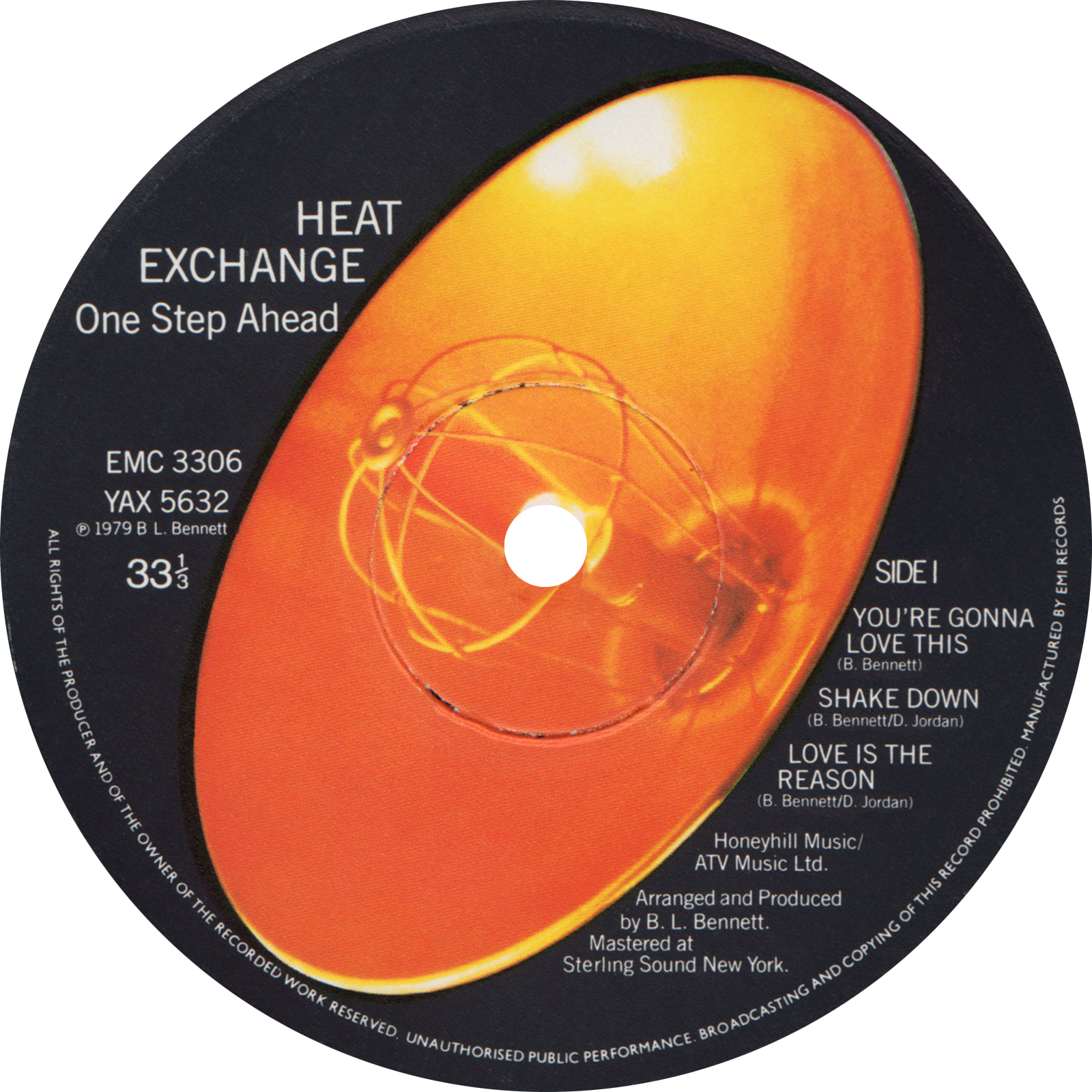
In 1977 he published his third proper solo album, "Rock Dreams", available here and credited to the Brian Bennett Band, which was followed the next year by "Voyage - A Journey Into Discoid Funk", a Disco/Funk opus that was recently remastered and re-released on vinyl and digital download. 1979 was also a busy year for Bennett, who was commissioned a Disco album by EMI; the result was "One Step Ahead", the subject of this post, credited to the Heat Exchange project.
From the 1990s to 2000, he was in demand more than ever and he composed music for the long-running series "The Knock", "Nomads of the Wind", "Global Sunrise", "Living Britain", "Dirty Work", "David Jason In His Element" and Hansjörg Thurn's film "The Arpist".
In 2009 and 2010 Cliff Richard and The Shadows embarked on a 50th anniversary tour with 36 shows in the U.K., Europe, Australia, New Zealand and South Africa. More recently, Bennett wrote with his son, Warren, 24 episodes of the award-winning TV series "New Tricks". He also recorded and produced an album with Cliff Richard and The Shadows.
In 2015 he worked on a musical called "Soho" and the music for a production called "Starchild". His latest album, entitled "Shadowing John Barry - New Recordings for Guitar and Orchestra", was released in February 2016... Although he will always be associated with The Shadows, playing drums for them is merely one aspect of a glittering musical career.
"One Step Ahead" contains the following tracks:
01. You're Gonna Love This (7:07)
02. Shake Down (6:55)
03. Love Is the Reason (7:58)
04. One Step Ahead (6:25)
05. Check It Out (5:52)
06. Lost On You (7:04)
All tracks were remastered from the original vinyl and CD re-issue in September 2017 and are available in FLAC lossless format, along with complete artwork reconstruction and printable PDF files.
As usual, please have a look at the comments for the download links.
"One Step Ahead" was released in the U.K. by EMI with cat. number EMC 3306 sometimes in 1977. The album was also released on cassette with cat. number TC-EMC 3306 and spawned a 12" single that featured "Shake Down" b/w "You're Gonna Love This" (12EMI 2988); edited versions of the same tracks were also released as a 7" single (EMI 2988).
In 1994, the album was re-released on CD by See For Miles Records under their C-Five Records inprint. The booklet offers precious information about Bennett and the album. The original notes were compiled by Rob Bradford, the following is a slightly edited and updated version:
«In 1985 Brian Bennett was delighted when he was commissioned to provide the complete score for the film "Terminal Choice". «Basically», he remarks, «I got that job because it was financed and set up in America. To the Americans, I was just another composer and they judged my music purely on its own merits. That was great. No preconceptions, you see? The majority of Americans have never even heard of The Shadows». In conversation it's a theme he returns to over and over again. The dangers of being musically typecast or pigeonholed. He cites many instances where he feels that his music has been dismissed as out of hand. Something along the lines of: "Brian Bennett? Isn't he The Shadows' drummer? We're looking for a musician, a composer - not a drummer!" In actual fact, playing drums for The Shadows for almost thirty years is only one facet of Brian's immense musical talent. His contribution to The Shadows was monumental and he will always, inevitably, be associated with them. However, Brian's other musical ventures have been both numerous and varied and his output of music as a composer has been truly prodigious.
Brian was always much more than just a beat group drummer. He studied the violin and musical theory for many years and successfully completed a course on orchestral arranging. In 1967 he released "Change of Direction", thus making him the first Shad to release a solo album. It was to be the first of many such projects. During the '70s Brian became a top session drummer as well as beginning his prolific output of library, TV and film music.
Heat Exchange was a commission that Brian undertook in 1979. He'd heard that EMI were looking for an album in the style of the then current Funk / Disco craze. «It all sprang from the New York club scene,» recalls Brian, «The Bee Gees struck lucky with "Saturday Night Fever" and then everyone went disco crazy. But one of the true originators was a guy called Sylvester. He was my starting point.» Sylvester James, Jr. was the doyen of disco music singers; his biggest hits were "You Make Me Feel (Mighty Real)" and "Dance (Disco Heat)".
As ever, Brian assembled a talented team of musicians including: Rickie Hitchcock (guitar), Les Hurdle (bass) and Mike Moran (keyboards). The vocalist we are not at liberty to divulge. I can tell you that he was British and has had chart success in his own right... «Guaranteed anonynimity was one of the conditions he insisted upon. He only did it as a one-off, for the money. But, I have to say that he was utterly brilliant. I've a feeling that Cliff Hall was on some tracks as well. For "Shake Down", I got Chris Lawrence to play the bass line. He had a genuine, groovy, pumping funk-disco style. I'm no lyricist. I enlisted a guy called Dave Jordan. He and I were on the staff of ATV music. He was someone I knew from weekly team meetings. I also had a brass section on there. I was thinking of stuff like Earth, Wind & Fire... Isaac Hayes and so on. I'd go over the scores with them... make suggestions... while we were all sitting around with drinks. All very relaxed. I wanted a party atmosphere. Then, they'd just cut it... live in the studio... hit a groove. I was delighted with it. When the whole thing was completed, I took it to Stirling Sound Studios in Manhattan to get it cut and mastered, to achieve that big 'Tuff' sound. Another thing that's worth mentioning is that all the drumming and percussion is yours truly. By that I mean that there are no drum machines, drum boxes, samplers, synth drums or whatever. No effects at all.»
It certainly does sound remarkably authentic. So authentic that it would have surely been chart material if given to a 'name' disco act to cover. This wasn't pastiche, it was Brian composing in a definite style. I asked Brian if he was pleased with the end product, particularly with regard to its authentic Disco style. «I was quite pleased with it. As a composer, you should be able to adapt to any particular style. Very few people realised it was me. It had the words 'Produced by B.L. Bennett' somewhere on the sleeve, in very small print. That was deliberate. The reviews were great in that they said things like... 'A tight set obviously recorded by top New York session men.' Great. It just goes to show that some critics don't know who they're listening to, or what they're talking about!»
"One Step Ahead", original rejected front cover artwork reconstruction
My copy of the album contains some notes - handwritten by the previous owner on the Side 2 center label - about the musicians featured on the recordings. Some of them are confirmed by Bennett himself in the interview that is quoted on the 1994 CD re-release; unfortunately the name of the singer remains a mystery... The picture above is based upon a tiny image included on the booklet of the aforementioned CD album.
Here's the credits and personnel list of "One Step Ahead":
Les Hurdle: bass Chris Lawrence: bass on "Shake Down" Rickie Hitchcock: guitar Mike Moran: keyboards Cliff Hall: additional keyboards Dave Lawson: additional keyboards Frank Ricotti: percussion Brian Bennett: drums Vicky Brown: backing vocals
All songs by Brian Bennett, except "Lost On You" written by Brian Bennett and Warren Bennett.
Lyrics on "Shake Down", "Love Is the Reason" and "Check It Out" by Dave Jordan.
Arranged and produced by Brian Lawrence Bennett.
Mastered at Sterling Sound, New York.
Brian Bennett playing drums
The following clips offer a complete preview of the remastered album, enjoy!
More information about Brian Bennett is available here:
If you have any other useful information about Brian Bennett, Heat Exchange and "One Step Ahead" - especially corrections and improvements to this post - or if you spot any dead links, please get in touch with me at stereocandies [at] hotmail [dot] com or leave a comment in the box below, thank you!
Facilitati bioritmi computerizzati
han calcolato la fine di questo pianeta:
l'asse polare si spezzerà
L'umanità si sveglierà al suono delle sfere
saremo avvolti da un rumore di fondo tra le colonie di Mercurio
e della Terra non resterà che un pallido ricordo
Nei frigoriferi cellule liofilizzate
uomini-quanti algoritmici codificati
l'ora legale simbolica
Un'unità ci guiderà sulla città satellite
pattuglie a sfera fatte solo di fuoco dentro agli anelli di Saturno
e della Terra non resterà che un pallido ricordo
[from the lyrics of "Auto-Motion"]
edit 05.04.2016
Filippo Destrieri, historical musical partner of Franco Battiato and Giusto Pio, and main programmer / performer of the electronic and rhythmic parts that make up "Auto-Motion", was kind enough to let me have more information about the subject of this post. He also offered some corrections to the lyrics of the song that I had tried, but in vain, to understand. This really made my day, THANK YOU!!!
This time I'll keep it short, you can read a detailed Giusto Pio biography in the aforementioned post or in the one I dedicated to "Legione straniera" some time ago.
"Auto-Motion (Otomoscion)" contains the following tracks:
Both tracks were remastered from the original vinyl in March 2016 and are available in FLAC lossless format, along with scans of the complete original artwork.
Please have a look at the comments section for the download link.
The single was released by EMI Italiana with catalogue number 06 1186667 sometimes in late 1984 and comes in a cover designed by Francesco Messina. No credits are given on the sleeve, but the author's style is easily recognisable, especially the 'alternating fonts' which he used on other works during those years.
Although producer Angelo Carrara is the only name credited on the labels, I understand that the same team of musicians and technicians who worked on the albums "Legione straniera" and "Restoration" in 1982/83 is also responsible for what we can hear on this precious little piece of vinyl. In particular, all the keyboards and rhythmic parts were played and/or programmed by Filippo Destrieri.
On Side A we find "Auto-Motion", a song composed by Franco Battiato and Giusto Pio, with lyrics by Saro Cosentino and - once again - Battiato, who also takes care about singing aided by a choir: I erroneously supposed this was the Madrigalisti di Milano ensemble, but I was told that actually they are the same musicians who participated in the recordings, along with studio technicians and whoever happened to be there on such occasion... The lyrics are all about an hypothetic future where the Earth cease to exist and humanity is forced to find a new home...
Interestingly enough, the song was used as the theme to "Chip" (...erroneously quoted as "Clips" both on the cover and label...), an Italian television broadcast about information technology that aired in September / October 1984. You can watch the original clip here below courtesy of Vimeo.
Side B offers an instrumental version of the same track, with Giusto Pio's prominent violin in place of the original vocal lines sung by Battiato.
Giusto Pio in the '80s
The following clips offer a complete preview of the remastered single. The original clip of the song is also included as a bonus, enjoy!
More information about Giusto Pio, Franco Battiato, Saro Cosentino, Filippo Destrieri, "Auto-Motion (Otomoscion)" and "Chip" is available here:
If you have any other useful information about this post or if you spot any dead links, please get in touch with me at stereocandies [at] hotmail [dot] com or leave a comment in the box below, thank you!
Giusto Pio was born in Castelfranco Veneto, Italy, in 1926. He inherited a passion for music from his father, who played several instruments without ever having attended regular schools.
At 13 he began to study violin in Marghera and three years later he was accepted at the Liceo Musicale Cesare Pollini of Padua. In 1941 he moved to Venice, where he studied composition and violin under Luigi Enrico Ferro, the last great violinist of the "Venetian School", at the Benedetto Marcelli Conservatory.
Pio graduated in violin in 1947, a few years later he got married and moved to Milan. During the '50s he received important national and international awards and entered the RAIorchestra of Milan (Italian television orchestra) as Concertino violin, a role that enabled him to acquire, in about thirty years of activity in close contact with the best directors and performers of the world, a wide experience in the field of orchestral-symphonic and operatic music.
During the '60s and the '70s, he also carried out an intense didactic activity with the best Milanese and Italian chamber music ensembles, contemplating a vast repertoire of music that, starting from the Middle Ages and Renaissance (Letitiae Musicae, the pioneer group in Italy for Medieval and Renaissance music), went through the Italian Baroque (Complesso Strumentale Italiano, Symposium Musicum Milano, Giovane Quartetto di Milano, Complesso Barocco di Milano, etc.), and then reached the contemporary music of today with many premières of the greatest Italian living composers.
Over the years Giusto Pio has participated in several recordings for the major record companies of the time (Ricordi, Angelicum, Vox, Decca). These musical performances were always philologically attentive, thanks to the help of musicologists such as Francesco Degrada and Raffaello Monterosso of the Musical Paleography School of Cremona.
In the late '70s Pio was hired by Franco Battiato as violin teacher and they soon became friends. Later on, almost for amusement and curiosity, Pio began to play improvised concerts with him and vocalist Juri Camisasca.
In 1978 he worked as musician on "Juke Box" by Battiato and during the same year he released his first album of experimental music entitled "Motore immobile" (...you can listen to the minimal title track here...) on Cramps Records.
The long collaboration with Battiato was one of the most prolific and interesting during the '80s and '90s in Italy; this partnership took Pio to new heights in the fields of commercial and avantgarde music, with a great success in terms of popularity and discography.
Most of the albums by Franco Battiato, from "L'era del cinghiale bianco" (1979) to "Unprotected" (1994), depending on the case, included Giusto Pio as co-author of the music or of the arrangements, as violinist or as conductor. All the tours performed by Battiato during those years always included Giusto Pio among the essential lineup of musicians.
"Restoration", original innersleeve
In those years, always with Battiato, he wrote the music and arrangements of many hit songs for Italian singers Alice, Giuni Russo and Sibilla ("Per Elisa" by Alice won the Sanremo Festival in 1981, you can watch the original performance here), produced two albums for Milva and various songs for other artists.
In 1984 Pio, Battiato and lyricist Rosario 'Saro' Cosentino penned the Eurovision Song Contest entry "I treni di Tozeur", performed by Alice and Battiato, which finished 5th in the contest and became a considerable commercial success in Continental Europe and Scandinavia. A video of the original performance, which briefly shows Giusto Pio as orchestra conductor, is available here.
Between 1982 and 1987 he released three album of Pop music ("Legione straniera", which I already remastered some time ago, "Restoration", the subject of this post, and "Note"). In particular, "Legione straniera" and "Restoration", both written along with Battiato, sold very well and Pio became a well-known name among the younger audiences, as evidenced by the musical chronicles of those years on many magazines and newspapers.
In 1988 he published "Alla corte di Nefertiti", an album that marked the passage to a music style which was very different from his previous output and had far less commercial appeal. His association with Pop music definively waned after the end of his artistic fellowship with Battiato.
"Restoration", original innersleeve
Over the past decade, Pio increasingly approached acoustic and electronic research, and produced music for theater (for example the play "Medea", for the Florentine group Krypton, which won first prize for music at the Massa Carrara Festival, or his collaboration on Battiato's operas performed in the major Italian theaters), music for movies and interactive musical comments with other art forms such as painting, sculpture and poetry.
Among his most recent music releases we remember "Utopie" (1990), "Missa Populi" (dedicated to His Holiness John Paul II, 1995), and "Le vie dell'oro" (2000).
Giusto Pio has turned 90 on 11 January 2016; while searching updated information about him for this post I discovered that he has recently suffered a serious domestic accident. Let this be my biggest congratulations to the Maestro, and I'd also like to take this opportunity to offer him my most sincere wishes for a full recovery.
Franco Battiato and Giusto Pio, early '80s
"Restoration - The Ancient School of Restoration" contains the following tracks:
01. Gente a lavoro (4:01)
02. Happy Morning (3:40)
03. Radio Taxi (3:42)
04. Jour de Fête (3:46)
05. Rodolfo Valentino (3:16)
06. Passato e presente (3:27)
07. El Condor (3:10)
08. Restoration (3:40)
All tracks were remastered from the original vinyl in January 2016 and are available in FLAC lossless format, along with complete artwork reconstruction and printable PDF files.
Please have a look at the comments for the download link.
As I already mentioned in the previous post dedicated to Giusto Pio, the overwhelming success of Franco Battiato's "La voce del padrone", co-arranged by Pio - the first Italian album with a certified sale of more than 1.000.000 copies - finally led him to come out into the open with "Legione straniera", his first Instrumental Pop album:
«Working with Battiato in a confident and unbiased way without any preconceptions has helped me to see Pop in a different light. For example, I learned that some songs written by Paul McCartney were every bit as good as some of Schumann's work.» [1]
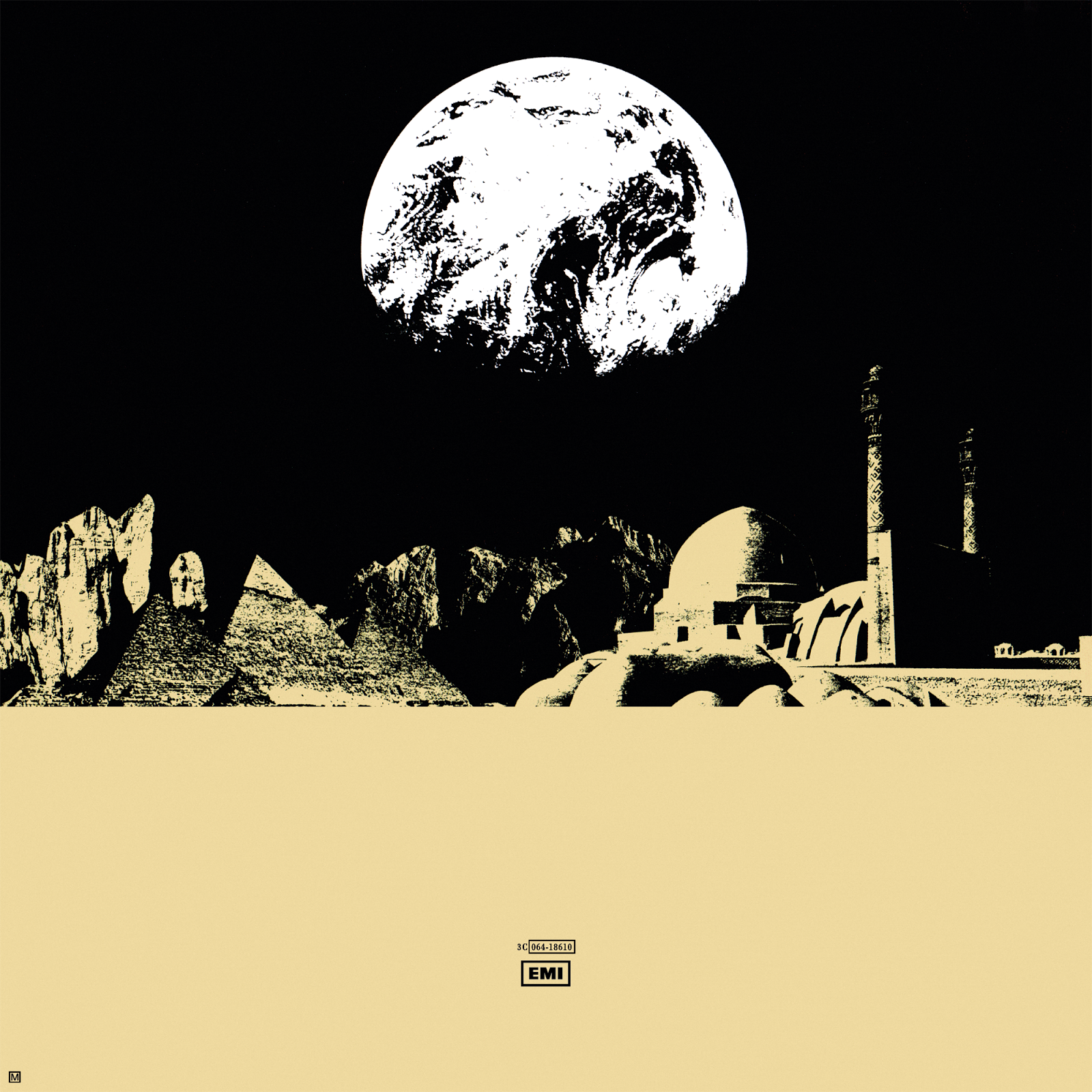
Recorded just one month earlier, "Restoration - The Ancient School of Restoration" was released by EMI Italiana with catalogue number 3C 064-18610 in March 1983; to date it has never been officially reissued on CD.
Once again, the album was produced by Angelo Carrara and co-written hand-in-hand by Pio and Battiato. Music, arrangements and stylistic features are quite similar to those contained on the LPs released by Battiato under his own name during the early '80.
Francesco Messina, Giusto Pio, Franco Battiato, Alberto Radius and Donato Scolese, circa 1981-82
«"Restoration" includes a few instrumental pieces composed by Franco (Battiato) and me; I also handled all the violin parts. It is mostly an album of Pop music, but it takes its title from a well known pavane by the French composer Gabriel Faurè that we reworked, as we had previously done with Bach, in our completely independent and peculiar way. In fact, when we registered it with SIAE (Italian collecting society for composers' copyrights) we presented both the original Faurè score and ours, so that the percentage of rights is shared between the heirs of the musician and us...» [2]
"Restoration" features the same team of musicians from the 'Battiato Factory' who already worked on "Legione straniera", including Paolo Donnarumma on bass, famous guitarist Alberto Radius and keyboardist Filippo Destrieri.
On this work Enzo 'Titti' Denna (...who probably engineered "Legione straniera" without being credited on the sleeve for an unknown reason...) also takes care of the Fairlight CMI programming, which is played by Destrieri. Compared to the previous release, "Restoration" sounds a bit more electronic to my ears, just like "L'arca di Noè" when compared to "La voce del padrone".
The elegant album cover, based on a drawing by Austrian painter Max Kurzweil, was designed by Francesco Messina «with the intention to 'paraphrase' the graphics of Deutsche Grammophon.» [3]
As already happened for the song "Legione straniera" the previous year, Battiato and Pio also took care of directing a promotional videoclip for the title track. Anyway, no song was issued as a single to 'drive' the album if we exclude this promotional item; I must admit that I don't remember having ever watched that clip then and unfortunately it hasn't resurfaced on YouTube yet... Anyway, you can watch a live performance of "Restoration" here.
One song from the album, "Rodolfo Valentino", was later given lyrics by Francesco Messina and released as a single by Italian singer Farida. Curiously enough, Giusto Pio was not credited as author on this release and Battiato appeared as Kui, one of his psudonyms... This version is available here.
Here's the complete credits and personnel list as translated from the back cover of "Restoration - The Ancient School of Restoration":
Music and arrangements by Franco Battiato and Giusto Pio.
Produced by Angelo Carrara.
Art Director: Francesco Messina
Music Publisher: Belriver s.r.l.
Front cover by Francesco Messina.
Drawing on front cover by Max Kurzweil.
Picture on back cover: Ilvio Gallo.
Keyboards: Filippo Destrieri
Drums: Alfredo Golino
Bass: Paolo Donnarumma
Guitars: Alberto Radius
Fairlight Computer (programming): Enzo 'Titti' Denna
Fairlight Computer (performing): Filippo Destrieri
Violins: Giusto Pio
Choir: Franco Battiato and Alberto Radius
Recorded at Radius Studio in February 1983.
Sound Engineer: Enzo 'Titti' Denna
Giusto Pio as he appears on the back cover of "Restoration"
The following clips offer a preview of the remastered album, please enjoy "Gente a lavoro", "Radio Taxi", "Rodolfo Valentino" and "Restoration"!
...and here's a live rendition of the title-track as performed in 1984 for an Italian television show; the audio sucks, but still is nice to see Mr. Pio and the band on stage!
More information about "Restoration - The Ancient School of Restoration", Giusto Pio and Franco Battiato is available here:
If you have any other useful information about this post or if you spot any dead links, please get in touch with me at stereocandies [at] hotmail [dot] com or leave a comment in the box below, thank you!
«Not since the great Ray Charles burst into the musical firmament has an entertainer illuminated contemporary music with the brilliance of Lou Rawls.
Having a string of smash hit albums to his credit, Lou approaches the material in this album with the supreme confidence and self-assuredness of a "star". He knows what to do. He knows he's right. And when you know you're right, you can hardly ever go wrong. And the combining of Lou Rawls with H.B. Barnum's music is a stroke of genius or good fortune (or both) unparalleled since someone at Capitol thought of putting Nelson Riddle together with Frank Sinatra.
There's no comparison intended of Lou to Ray Charles or Frank Sinatra or anybody else. For Lou is not an imitation of anyone. Lou Rawls is his own man. He's himself. But like any great artist, he lifts his voice from roots in a million dim yesterdays. He speaks and sings to us of now, today. But the truth is for always. So the emergence of Lou Rawls is as natural and inevitable as evolution.
The genius of Lou Rawls is that he communicates - to a stadium full of people - to just you two together - on stage or on record. He explodes on an audience with stunning emotional impact. Lou generates an electric excitement, glowing with gospel fervor, smouldering with intensity and gleaming with high good humor.
It's hard to think or talk about Lou without saying "soul" somewhere. I've tried to avoid it because "Soul" has been used, abused and mis-used so much that now it seems to be just a word that some people put on album covers in the hopes of selling some records. But when you come up against the real thing, you don't have to read it or see it or say it. You feel it. And, baby, That's Lou!»
[Jim Gosa, from the original back sleeve notes of "That's Lou"]
Lou Rawls was an American soul jazz and rhythm and blues singer with extraordinary artistic longevity and great generosity. His soulful singing career spanned over thirty years, and his philanthropy included helping to raise over 150 million dollars for the United Negro College Fund (UNCF). He released more than 75 albums, selling about 40 million records worldwide, appeared as an actor in films and on television, and voiced-over many cartoons. He had been called "The Funkiest Man Alive" and his friend Frank Sinatra once said that he had "the classiest singing and silkiest chops in the singing game".
Born Louis Allen Rawls on December 1, 1936 in Chicago, son of a Baptist minister and a homekeeper, Lou Rawls was raised on the South Side by his grandmother and was introduced to gospel at age seven in the choir of the Greater Mount Olive Baptist Church.
As a teenager he developed an interest in the jazz-influenced songs of Billy Eckstine and Joe Williams, whose resonant baritone voices were similar to his own voice. He soon joined doo-wop quartets and sang with the West Singers and the Kings of Harmony, he first recorded in June 1950 with The Holy Wonders. After his grandmother died, he moved to Los Angeles in 1953 and joined the Chosen Gospel Singers.
In the mid-1950s Rawls toured with another gospel group, The Pilgrim Travelers, who recorded for Specialty Records. After graduating from Chicago Dunbar Vocational Career Academy he joined the U.S. Army in 1955 as a paratrooper for about three years. When he returned from military service, he started touring again with the group. One rainy night in November 1958 their car collided with a semi-trailer truck: Eddie Cunningham was killed, Cliff White broke his collarbone and Sam Cooke was hardly injured. Rawls laid in a coma for five days before waking and eventually recovering from the severe concussion, it took him about one year to fully recup.
"That's Lou" original inner sleeve shows Capitol goodies of 1967...
The accident contributed to the dissolution of The Pilgrim Travelers and Rawls embarked on a solo career in 1959. The group were based in Los Angeles, so Rawls decided to stay there after the breakup. A producer from Capitol Records noticed him performing at Pandora's Box coffee shop and the label signed him in 1961. During the same year Rawls recorded anonymously as an uncredited background singer on Sam Cooke's "Bring It On Home To Me", which is considered a classic nowadays.
It took Rawls a while to establish himself as a solo artist, his first recordings were fairly successful. He debuted in 1962 with "Stormy Monday", an album that featured a number of blues and jazz standards chosen by Rawls and backed by the Les McCann Trio.
His 1963 album "Black and Blue", made the pop chart and other four albums followed in just three years ("Tobacco Road", "For You My Love", "Lou Rawls and Strings" and "Nobody But Lou"), but it wasn't until 1966 that he crossed over to major market success with "Lou Rawls Live!". The album was released in April and went to #1 in the Billboard R&B Albums Charts and to #4 in the Billboard Pop Albums Charts. Although it became
the first of his several gold albums, Rawls would not have a star-making hit until he made a proper soul album.
...and more goodies on the back.
The aptly entitled "Soulin'" was released in August 1966, just four months after the success of "Live!". It contained Lou's first R&B #1 single, "Love Is a Hurtin' Thing", which also went up to #13 on the Pop Charts.; with this song he earned his first Grammy Award nomination. Finally, after a few years of struggling, Rawls was reaching white audiences with his smooth baritone.
Produced by David Axelrod, "Carryin' On!" (...available here) was released during the very last week of 1966, exactly on December 27. Rawls got two mild hits from this album with "Trouble Down Here Below" and "You Can Bring Me All Your Heartaches"; it is also worth mentioning his fine renditions of "On Broadway" and The Beatles' "Yesterday". The production and arrangements were perfectly tailored to his voice, the songs were good, and Rawls sounded confident, assertive, and soulful. "Carryin' On!" went to #2 in the Billboard R&B Albums Charts, to #3 in the Jazz Albums Charts and to #20 in the Pop Albums Charts.
In the midst of Rawls' hot streak at Capitol, "Too Much!" (...available here) was released on April 17, 1967. It was the first of three albums released during the same year, all of which made the Top 40 in the Pop Albums Charts. The album was superbly produced by David Axelrod and arranged by H. B. Barnum, with Rawls being bluesy, soulful, anguished, triumphant, and resigned. "Too Much!" was #1 on the Billboard Jazz Chart, #2 on the Billboard R&B Album
Chart and #3 on the Billboard Pop Album Chart.
In June 1967 Rawls performed live at the Monterey Pop Festival, a now legendary musical event, which featured a range of performers, from Otis Redding to The Grateful Dead and The Jimi Hendrix Experience.
During the same month, Capitol released a new single with two songs Rawls had recently recorded; "Show Business" was placed on Side A backed with "When Love Goes Wrong" on the flipside. The single featured one of Rawls' trademark monologues about the joys and pains of being a celebrity; it was #25 on the Billboard R&B Chart and #45 on the Billboard Pop Chart. Strangely enough, "Show Business" wasn't included on "That's Lou", the new Lou Rawls album that Capitol released in August 1967, which is the subject of this post....
Lou Rawls performing on TV, circa 1967
"That's Lou" contains the following tracks:
01. When Love Goes Wrong (2:37)
02. Problems (2:04)
03. Reminiscing Monologue (1:17)
04. They Don't Give Medals (To Yesterday's Heroes) (2:13)
05. Ear Bender Monologue (1:02)
06. What Are You Doing About Today (2:12)
07. Please Give Me Someone To Love (3:49)
08. Hard To Get Thing Called Love (3:15)
09. (How Do You Say) I Don't Love You Anymore (2:49)
10. Street of Dreams (2:58)
11. The Love That I Give (2:32)
All tracks were remastered from the original vinyl in October 2014 and are available in FLAC lossless format or high-quality 320 Kbps MP3 files. Both formats offer complete printable PDF artwork.
Before you burn this album on CD-R using the provided CUE file you must convert the original files to WAV format using an appropriate software. Here's an option for FLAC to WAV conversion and one for MP3 to WAV conversion.
As usual, please have a look at the comments for the download links.
Produced once again by David Axelrod, "That's Lou" was #5 on the Billboard Jazz Chart, #5 on the Billboard R&B Album
Chart and #29 on the Billboard Pop Album Chart.
The album starts with "When Love Goes Wrong", a track written by lyricist Ben Raleigh (responsible for a number of major hits by Nat King Cole, Johnny Mathis, Aretha Franklin, Dinah Shore and many others, including - of course - Lou Rawls) and James Woodie Alexander, once manager of The Pilgrim Travelers and Rawls' personal advisor and confidant. The song, which is probably the best cut on the album, also appeared on Side B of the "Show Business" single a few months earlier.
Credited to Rawls himself, "Problems" is all about "being in control of your life, so that you are successful and are doing what you want to do" because "you can only take out what you put in it". This theme is explored all over Side A with two short monologues, a rendition of a Bacharach / David composition "They Don't Give Medals (To Yesterday's Heroes)" - also recorded by Ben E. King (...available here) and Chuck Jackson (...here) - and "What Are You Doing About Today", another song penned by Rawls and J.W. Alexander.
The second side of "That's Lou" is more rooted in Jazz and Blues, and offers slower compositions. The opening "Please Give Someone To Love" is a ballad originally written and recorded by Percy Mayfield, which has been covered by many artists during the years. The original version is available here.
"Hard To Get Thing Called Love" was written by Vincent Poncia and Pete Andreoli: it was originally performed by Tony Bruno (...here...) and Deon Jackson (...here...) in 1966; I'm not sure about who recorded it first... A promotional single of this track was produced for radios, but it was never officially released to the public.
"(How Do You Say) I Don't Love You Anymore" is a song by Al Kooper and Irwin Levine, which was chosen as the title-track of Freda Payne's third album recorded in 1966. The original version is available here.
"Street of Dreams" is an old classic composed in 1932 by Victor Young, with lyrics by Sam M. Lewis. It was first recorded by none other than Bing Crosby! You can listen to the original here.
The album ends with "The Love That I Give", a song credited to Rawls himself.
James Woodie Alexander and Lou Rawls, circa 1967
During the late 1960s, Rawls appeared regularly on TV variety shows and became a show-room figure in the nightclubs of Las Vegas. In 1970 he recorded a single entitled "Your Good Thing Is About To Come To an End," a title that contradicted the success he experienced in the Seventies. The song was nominated for a Grammy Award.
He switched to MGM Records in 1971, "A Natural Man" was the first album he recorded with them. The homonymous single earned Rawls a second Grammy Award in 1972. He released two more albums with MGM but the hits stopped cold...
It took a chance meeting with Weldon McDougal of Philadelphia International to radically alter Lou Rawls's stalled recording career, but this is a story that will be extensively covered at a later date in a different post.
In 1989 Rawls' hometown of Chicago named a street after him: South Wentworth Avenue was renamed Lou Rawls Drive. He died on 6 January, 2006 in Los Angeles, California.
The following clips offer a preview of the remastered album, here's my favourite tracks: "When Love Goes Wrong", "Problems", "What Are You Doing About Today", and "Hard To Get Thing Called Love", enjoy!
If you have any other useful information about Lou Rawls and "That's Lou" - especially corrections and improvements to this post - or if you spot any dead links, please get in touch with me at stereocandies [at] hotmail [dot] com or leave a comment in the box below, thank you!